
AI Skills Are No Longer Limited to Tech Jobs, as Finance and Professional Services Hire for AI-Aligned Roles


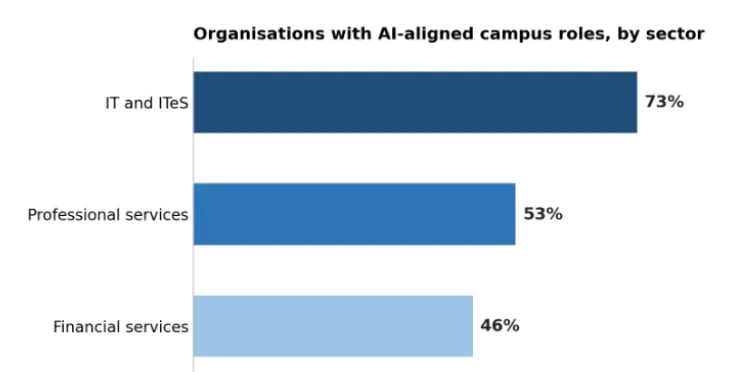
Ask most people where AI skills get hired, and they will say technology. The latest campus hiring data tells a different story. Deloitte India’s Campus Workforce Trends 2026 report finds that 53 per cent of professional services firms and 46 per cent of financial services firms now have AI-aligned campus roles, behind only IT and ITeS at 73 per cent.
That is a notable shift. AI and data skills now attract hiring premiums of 20 to 25 per cent, and 35 per cent of organisations say AI is creating new entry-level roles or skill requirements, up from 21 per cent in FY25.
So what does this mean if you are about to enter the job market, or are hiring for it? Three things stand out: AI roles are spreading across sectors, the skills premium is reaching beyond technology, and employers are looking at behaviour as much as at code.
AI and data skills now carry a 20 to 25 percent hiring premium, and that premium is no longer confined to technology roles.
How Far Has AI Spread Beyond IT?
Recruitment budgets rose 19 percent, and 80 percent of organisations now run dedicated campus hiring teams.
Overall, recruitment budgets rose 19 per cent as employers stepped up investment in early-career talent, and 80 per cent now maintain dedicated campus hiring teams.
Do AI Skills Pay Off Outside Technology?
The skills premium extends well beyond technology roles.
AI and data skills, covering AI development, cybersecurity, data science and Industry 4.0, attract hiring premiums of 20 to 25 percent. Analytical thinking and problem-solving command 10 to 15 per cent.
The premium also reaches other fields. Bioinformatics and biopharmaceutical capabilities attract 20 to 25 per cent, and the report names several domain pathways that are emerging as differentiated:
-
Legal technology
-
M&A
-
Digital health
-
Sustainable finance
-
Consumer analytics
-
Industrial cybersecurity
-
Smart-factory capabilities
Credentials still carry weight. CA and CFA rank holders receive about 43.5 percent higher median compensation than non-rank holders, at INR 20.95 lakh against INR 14.60 lakh.
Tip: Pair your degree or credential with one demonstrable AI or data skill. The report describes pay as a three-part valuation: institute tier, role and specialisation, and demonstrable critical skills.
What Does an AI-Ready Early-Career Role Look Like?
At Top 10 campuses, hiring leads to roles such as AI/Digital Product Manager and Data Scientist. At Tier 1 to 3 campuses, it shifts towards Business Analyst, Software Engineer, Operations Analyst and Management Trainee positions. Among engineering degrees, Data Science and AI Engineering carries the highest premium, at 9 per cent.
Employers are also prioritising human capabilities alongside technical expertise. Learning agility, adaptability, collaboration and role-specific skills are becoming more important in campus hiring decisions.
For converting interns to full-time hires, employers rank behavioural competencies (75 per cent) and learning agility (72 per cent) ahead of technical competencies.
How Is AI Changing the Way Employers Hire?
The same technology is reshaping both the roles and the recruitment.
86 per cent of organisations say AI or Agentic AI is transforming their recruitment processes.
AI is now embedded across screening, assessment and candidate evaluation. The most common uses:
-
Resume screening: 72 percent of organisations
-
AI-based assessments: 48 percent
-
Candidate engagement: 37 percent
-
Predictive hiring tools: 33 percent
AI-led video interviewing is also emerging as a new screening tool. Internship-to-offer conversions improved by about 6 percent year-on-year, with gains across all covered degree categories.
What Does This Mean for Fresh Graduates?
Sustained skilling is the common thread.
Technology remains the most preferred sector for students for the fifth consecutive year, followed by financial services. Yet pay outcomes still depend heavily on institute tier. Talent from Tier 2 and Tier 3 campuses must rely heavily on experience, tenure, upskilling and later role mobility.
"Sustained skilling, aligned to emerging roles, will determine both employability and value creation." — Dr. Neelesh Gupta, Partner, Deloitte India
Tip: Check which AI and data skills the roles you want now ask for, and build one before you apply.
Key Takeaways
-
AI-aligned campus roles are most common in IT and ITeS (73 percent), followed by professional services (53 percent) and financial services (46 percent).
-
35 percent of organisations say AI is creating new entry-level roles or skill requirements, up from 21 percent in FY25.
-
AI and data skills attract hiring premiums of 20 to 25 percent, and analytical thinking and problem-solving 10 to 15 percent.
-
The premium extends to bioinformatics, legal technology, M&A, sustainable finance, consumer analytics and other domains.
-
Employers rank behavioural competencies and learning agility ahead of technical skills for PPO conversion.
-
86 percent of organisations say AI or Agentic AI is transforming recruitment, led by resume screening at 72 percent.
So, Are AI Skills Still Only for Tech Jobs?
No, technology still leads, but about half of professional services and nearly half of financial services firms now have AI-aligned campus roles. Pay is as follows: AI and data skills carry a 20 to 25 percent premium, and similar premiums are appearing in fields from M&A to bioinformatics.
For graduates, that makes AI skill a career question rather than a tech-sector one. For employers, it means the competition for early-career talent now runs across sectors, with skilling and behavioural strength deciding who stays and grows.
Before choosing a degree or a sector, check which AI and data skills the roles you want now ask for.