

CA and CFA Rank Holders Earn 43.5% More at the Median, Highlighting the Value of Professional Credentials
 Avisha Das16 Oct, 2026


A professional qualification can strengthen your career prospects, but does passing an exam automatically translate into higher pay?
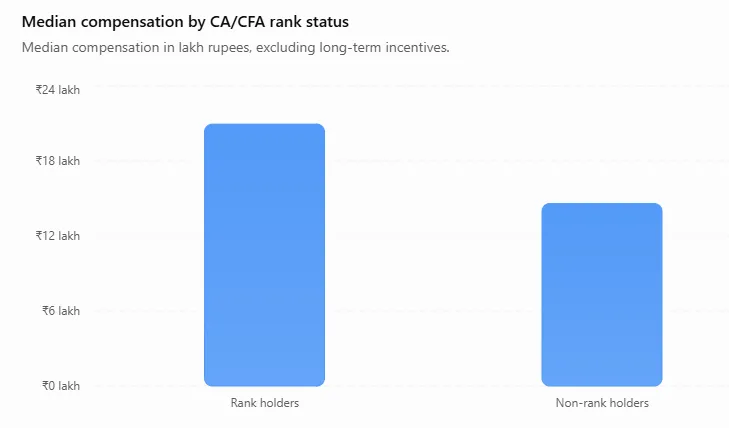
Deloitte India’s Campus Workforce Trends 2026 report offers a useful data point: CA and CFA rank holders receive approximately 43.5% higher median compensation than non-rank holders.
This finding stands out in a campus hiring market where employers value specialist knowledge, analytical ability, and skills relevant to specific roles. Yet the pay difference also sits within a wider compensation picture shaped by institute tier, degree, specialisation and the capabilities a candidate brings to the job.
THE BIG TAKEAWAY: Professional credentials can add value to a candidate’s profile, but the 43.5% figure is a reported median compensation difference between CA/CFA rank holders and non-rank holders. It does not mean every rank holder will earn 43.5% more, or that the qualification alone explains the difference.
What Does Deloitte’s 43.5% Compensation Finding Reveal?
In Deloitte India's study, CA and CFA rank holders had a higher median compensation than non-rank holders, highlighting a potential advantage of strong professional exam performance.
According to Deloitte India’s Campus Workforce Trends 2026 report, CA/CFA rank holders recorded a median Total Cost to Company (TCC), excluding Long-Term Incentives (LTI), of Rs. 20.95 lakh, compared with Rs. 14.60 lakh for non-rank holders.
The difference is Rs. 6.35 lakh at the median. Expressed relative to the non-rank-holder figure, this is approximately 43.5%.
The finding suggests that professional exam performance can be a meaningful point of differentiation in the compensation market covered by the report. Rank holders may stand out through demonstrated subject knowledge, exam performance and their potential fit for roles requiring financial, accounting or analytical expertise.
However, the figures do not establish that securing a rank directly causes a higher salary. The report summary does not isolate the effects of experience, employer, job function, institute or other candidate characteristics on this pay gap.
Do Professional Credentials Actually Make Employers Notice You?
A professional qualification can signal specialist knowledge, but its value depends on how that knowledge fits the role and the employer’s requirements.
CA and CFA qualifications are associated with different areas of finance and business. CA training focuses on areas such as accounting, audit, taxation and financial reporting, while the CFA programme focuses on investment analysis, valuation, portfolio management and related financial topics.
For employers hiring into relevant roles, these qualifications can help demonstrate that a candidate has studied technical concepts and met demanding assessment requirements. A strong exam result may provide an additional signal of subject mastery.
That signal is only one part of hiring, however. Employers also need to assess whether candidates can apply what they know, interpret information, communicate findings and make sound decisions.
A qualification may help establish a foundation, while practical experience shows how a candidate uses it at work.
Deloitte’s wider findings support this distinction between credentials and other hiring signals. The report identifies institute tier, role and specialisation, and demonstrable critical skills as important layers of compensation differentiation. It also reports pay premiums for AI and data skills, as well as analytical thinking and problem-solving.
A credential can help a candidate demonstrate knowledge. The ability to apply that knowledge to a real business problem helps show its value in practice.
A quick self-check for aspiring finance professionals
Before choosing a qualification, consider:
-
Which roles do I want to pursue: audit, taxation, investment research, corporate finance or another area?
-
Does the qualification match the knowledge those roles require?
-
Can I combine exam preparation with practical projects, internships or relevant work experience?
-
What are the eligibility, time, examination and financial commitments involved?
These questions can help you compare qualifications based on career fit rather than salary figures alone.
Is Professional Qualification the Biggest Factor Behind Higher Compensation?
Deloitte’s findings point to several sources of pay differentiation. Professional exam performance is one reported signal, while institute tier, specialisation and job-relevant skills also matter.
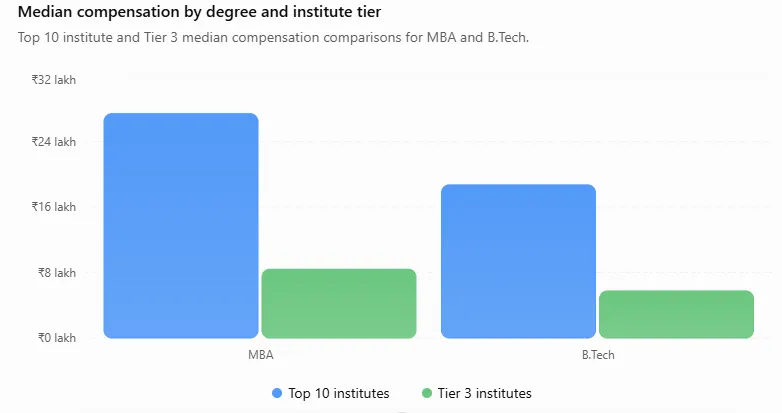
The CA/CFA comparison is one part of a broader compensation picture in Deloitte India’s report. Differences between institute tiers are also substantial in the degree categories covered.
For MBA graduates, median compensation stood at Rs. 27.4 lakh at Top 10 institutes, compared with Rs. 8.4 lakh at Tier 3 institutes. For B.Tech graduates, the corresponding figures were Rs. 18.7 lakh and Rs. 5.75 lakh.
These figures show why it would be misleading to attribute compensation outcomes to a single factor. The report presents differences by institute tier and degree, alongside premiums linked to specialisations and critical skills.
The report also identifies other differences in compensation:
-
AI and data skills: Reported hiring premiums of 20–25%.
-
Analytical thinking and problem-solving: Reported premiums of 10–15%.
-
Degree and specialisation: Business Management recorded a 15% pay premium among the MBA specialisations discussed, while Data Science and Artificial Intelligence Engineering recorded a 9% premium among engineering specialisations.
-
Institute tier: The report shows substantial median compensation differences between Top 10 and Tier 3 institutes.
These premiums relate to the categories described in the report. They should not be added together or assumed to apply equally to every candidate.
Want to go beyond credentials and show employers what you can do with data? Explore the Post Graduate Certificate Programme in Business Analytics and Generative AI to build analytical capabilities relevant to data-driven business roles.
How Are Employers Valuing Skills Alongside Qualifications?
Employers are placing greater emphasis on specialist and practical capabilities, so qualifications are best considered alongside the skills required for the roles you want.
Deloitte reports that AI and data skills attract hiring premiums of 20–25%, while analytical thinking and problem-solving attract premiums of 10–15%. These capabilities are not limited to technology jobs. The report also identifies demand for specialised knowledge across areas such as sustainable finance, consumer analytics, legal technology and digital health.
For finance aspirants, this points to a practical question: what can you do with the knowledge you gain?
Depending on your career direction, useful complementary capabilities may include financial modelling, spreadsheet analysis, interpreting financial statements, valuation, data analysis and communicating findings clearly. The most relevant combination will vary by role.
THE PRACTICAL LESSON: Choose learning opportunities that help you perform tasks relevant to your target role. A credential may help demonstrate what you have studied; projects and experience can show how you apply it.
Interested in how AI is reshaping finance? Explore the AI-driven FinTech programme from IIT Roorkee.
Should You Pursue CA or CFA for Better Salary Prospects?
Choose a qualification based on the career path it supports, not the 43.5% compensation gap alone.
The Deloitte finding may make professional qualifications worth considering, but it cannot tell every student which path is best. CA and CFA differ in focus, eligibility, examination requirements, time commitment and the kinds of roles they can support.
Before deciding, compare the qualification with the work you want to do. Review the syllabus and exam pathway, speak with people working in your target roles, and look at the entry requirements in relevant job descriptions. Consider whether you enjoy the subject matter enough to sustain the preparation required.
It is also worth thinking about the wider career plan. A professional qualification may be combined with internships, projects, postgraduate study or role-specific technical training. The right combination depends on your starting point and goals, not on collecting as many credentials as possible.
Key Takeaways
-
CA/CFA rank holders recorded median compensation of Rs. 20.95 lakh, compared with Rs. 14.60 lakh for non-rank holders, excluding LTI.
-
The median difference is approximately 43.5%, but it does not mean every rank holder earns that much more.
-
Institute tier also matters: Deloitte reported sizeable median compensation differences between Top 10 and Tier 3 institutes for both MBA and B.Tech graduates.
-
Skills create another layer of differentiation: AI and data skills attracted reported premiums of 20–25%, while analytical thinking and problem-solving attracted 10–15%.
-
Qualifications work best when aligned with career goals: Practical application, role fit and relevant experience remain important considerations.
-
The report shows associations, not a universal salary formula: It does not establish that a CA or CFA rank alone causes higher compensation.
The Bottom Line: What Does the 43.5% Pay Difference Mean for Students?
Deloitte India’s Campus Workforce Trends 2026 report highlights a meaningful compensation difference between CA/CFA rank holders and non-rank holders. The finding reinforces the potential value of strong professional exam performance, particularly in fields where specialist knowledge is important. But it should not be treated as a promise of higher pay or proof that a rank alone determines career outcomes.
For students and early-career professionals, the more useful takeaway is to build a profile that connects qualifications with the work they want to do. Compare career paths, develop relevant skills and seek opportunities to apply what you learn. A professional credential can strengthen your case, but its long-term value depends on how well it fits your goals and how effectively you use the knowledge it represents.