
Graduates From Tier 2 and Tier 3 Colleges Can Build Career Mobility Through Experience and Upskilling
 Mishika Gupta16 Oct, 2026


Your first job offer can feel like a verdict on your potential. If a graduate from a Tier 1 college starts with a significantly higher salary, it is easy to wonder whether your own career has already fallen behind.
But is your first salary a prediction of your entire career?
Not necessarily. The starting line is unequal, and that reality deserves acknowledgement. Yet your first job is only one point in a much longer professional journey, one shaped by the experience you gain, the skills you develop and the opportunities you learn to pursue.
Deloitte India’s Campus Workforce Trends 2026 highlights both sides of this picture: institute-tier differences in compensation remain substantial, while experience, upskilling and subsequent role mobility are important for graduates from Tier 2 and Tier 3 colleges.
Your college may influence your first opportunity. What you learn and demonstrate after joining can influence what comes next.
The Starting Salary Gap is Real
Deloitte’s findings show just how differently campus compensation can vary by institute tier.
-
MBA graduates: Median compensation of Rs. 27.4 lakh at the Top 10 institutes, compared with Rs. 8.4 lakh at Tier 3 institutes.
-
B.Tech graduates: Median compensation of Rs. 18.7 lakh at the Top 10 institutes, compared with Rs. 5.75 lakh at Tier 3 institutes.
These are reported median compensation figures, not guaranteed packages for every graduate. They nevertheless highlight a significant difference in starting opportunities.
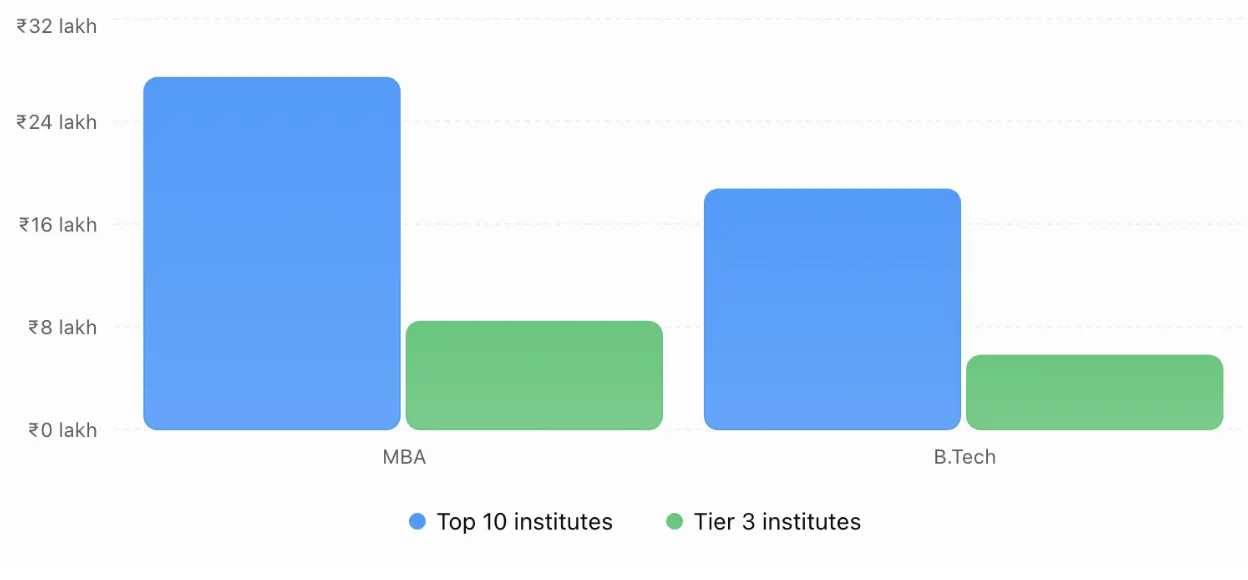
Source: Deloitte India, Campus Workforce Trends 2026. These are median compensation figures; actual offers vary by role, employer, location and candidate profile.
The lesson is not to ignore the gap. It is to recognise that your first offer is a starting point for career planning, not a measure of your ultimate professional worth.
1. Treat Your First Job as a Learning Platform
When comparing your first offers, salary matters, but so does what the role allows you to learn.
Will you work with real customers, analyse business data, solve operational problems or contribute to projects? Will you receive feedback and have opportunities to take on greater responsibility?
A role that builds transferable skills can open doors later, even if the initial package is modest. That does not mean accepting poor working conditions or settling indefinitely for low pay. It means evaluating your first role for both immediate value and future possibilities.
A job becomes a career-building opportunity when you can point to what you learned, improved or delivered.
2. Upskilling Works Best When It Solves a Real Problem
Upskilling is often presented as a simple formula: learn a trending skill, earn a certificate and get a better job. In practice, the connection is less automatic.
A course can introduce concepts, but employers also want to know whether you can apply them. Deloitte reports that AI and data skills attract hiring premiums of 20–25%, while analytical thinking and problem-solving attract premiums of 10–15%. These are reported skill premiums, not guaranteed salary increases for individuals.
So, what should you learn?
For instance, if you want to move towards digital finance, understanding how technology is changing financial products and services can help you identify relevant skills to build. Exploring digital finance and fintech learning could be one way to investigate this specialisation before deciding on your next learning step.
The point isn't to learn everything. It's to build skills that make sense for the role you want next.
3. Build Proof of Your Skills, Not Just a List of Certificates
Imagine two candidates applying for a data-related role. Both have completed an online course. One lists the certificate on their resume. The other can also demonstrate a project in which they analysed a dataset, identified a pattern and explained a business recommendation.
Which candidate gives an employer more evidence to evaluate?
The second candidate has made their learning more visible.
You can build that evidence through projects, internships, freelance assignments, volunteering or improvements you contribute at work. Keep a record of the problem, your approach, the tools you used and the outcome. Be honest about your contribution and avoid sharing confidential employer data.
Your portfolio doesn't need to be impressive because it's complicated. It needs to show how you think and solve problems.
4. Use Experience to Move Towards Better Opportunities
Your first role does not have to define your specialisation for the next ten years. As you gain experience, you can build towards roles with greater responsibility, stronger technical requirements or closer alignment with your interests.
For example, a customer support professional might develop reporting and process-improvement skills before moving towards operations analysis. A finance associate might build data and automation capabilities to pursue analytical responsibilities.
These transitions are not automatic. They depend on relevant skills, performance, available openings and the requirements of the target role.
Deloitte's findings also point to the importance of learning agility, adaptability and problem-solving in early-career hiring. Career mobility often begins before you change jobs: it starts when you take on work that prepares you for the next role.
To understand how skills and professional development shape longer-term progression, explore these factors that influence career growth after an MBA.
A Practical Career-Mobility Plan
You do not need to transform your career overnight. Start with a manageable plan:
-
Choose a target role: Study several relevant job descriptions and identify the skills they repeatedly require.
-
Identify one skill gap: Focus on a capability that appears important across those roles.
-
Practise through a real task: Complete a project that demonstrates the skill in context.
-
Seek feedback: Ask a mentor, colleague or knowledgeable professional where your work can improve.
-
Review your progress: Update your résumé with genuine achievements and reassess your next step every few months.
Not sure where to begin? The right tools can help turn a broad career goal into a clearer action plan. Explore the PW Medharthi Tools Hub to discover resources that can help you assess your skills, explore career options and plan your next move.
Key Takeaways
-
Starting salaries vary significantly by institute tier, and that gap should not be dismissed.
-
Experience can help you build transferable skills and qualify for new opportunities over time.
-
Upskilling is most valuable when it addresses a real skill gap.
-
Projects and measurable achievements make your capabilities easier for employers to assess.
-
Career mobility depends on performance, relevant skills and available opportunities—not certificates alone.
Your First Job is a Chapter, Not the Whole Story
It is fair to want a stronger starting salary. It is also fair to feel frustrated when college reputation influences access to opportunities.
But the more useful question is what you can build from where you are now.
You cannot rewrite where your career began, but you can be deliberate about what your next opportunity requires you to learn. Experience gives you context. Upskilling helps you adapt. Demonstrable results give others a reason to trust your abilities.
The goal is not to prove that college differences never matter. They do. It is to keep those differences from becoming the only story you tell yourself about your future.