
GMAC Report Finds Growing Employer Demand for AI Skills Among Graduates
 Kishor Kumar Bairagi14 Oct, 2026
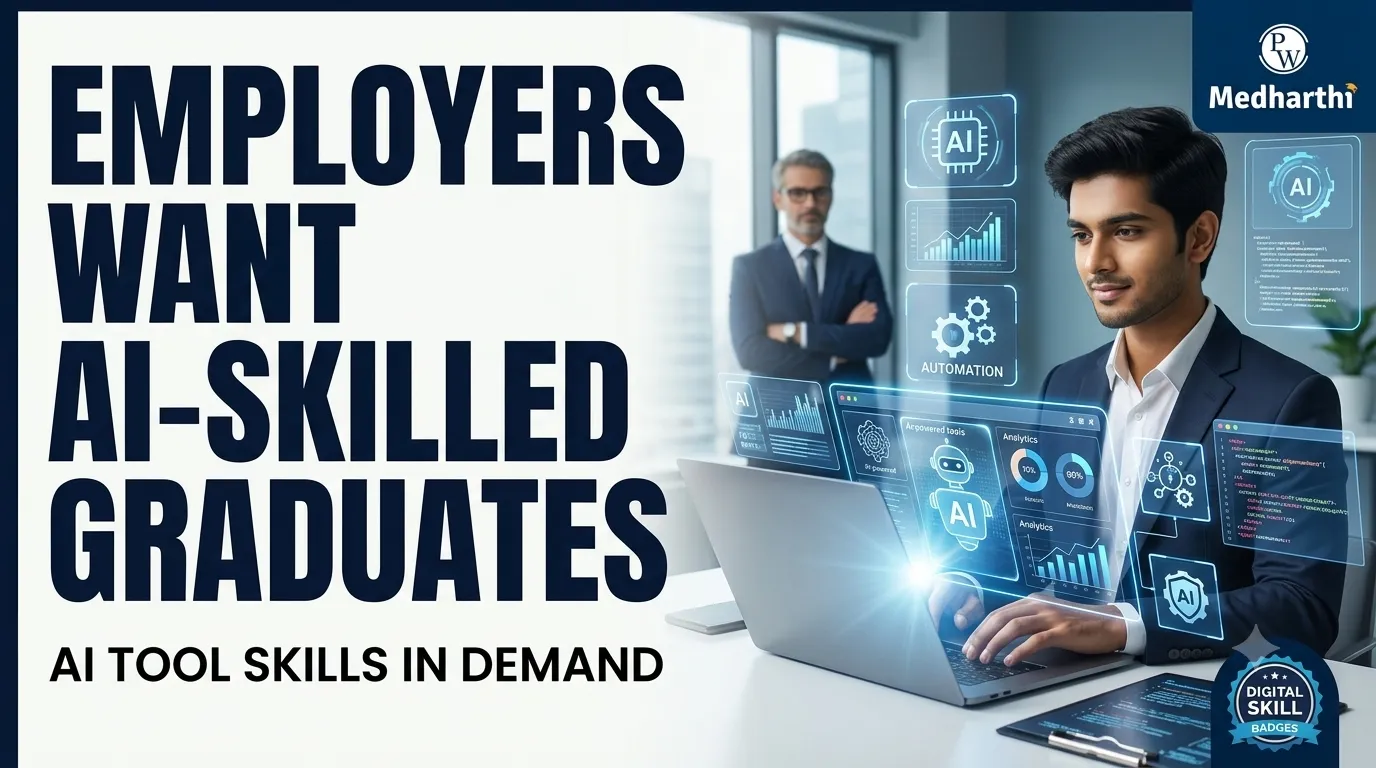
AI skills are becoming part of the conversation around graduate employability, but what exactly are employers looking for? The GMAC 2026 Corporate Recruiters Survey found that 44% of employers value skills using AI tools, while 59% value data analysis and interpretation.
Among employers who consider AI capabilities important, 67% want graduates to use AI to automate tasks. Based on responses from 621 recruiters and hiring managers across 39 countries, the findings show that employers are looking beyond simple AI tool usage towards the ability to apply technology to real workplace tasks.
AI Tool Skills Are Gaining Importance Among Employers
According to GMAC's 2026 survey, skills using AI tools recorded one of the largest increases in importance over the previous year, alongside data analysis and interpretation and other technology/IT skills. However, AI tool skills are not currently the most frequently selected capability among employers.
Communication skills were cited by 64% of employers, followed by problem-solving at 62% and adaptability at 60%. Skills using AI tools were cited by 44% of employers.
Employer-Valued Skills in 2026
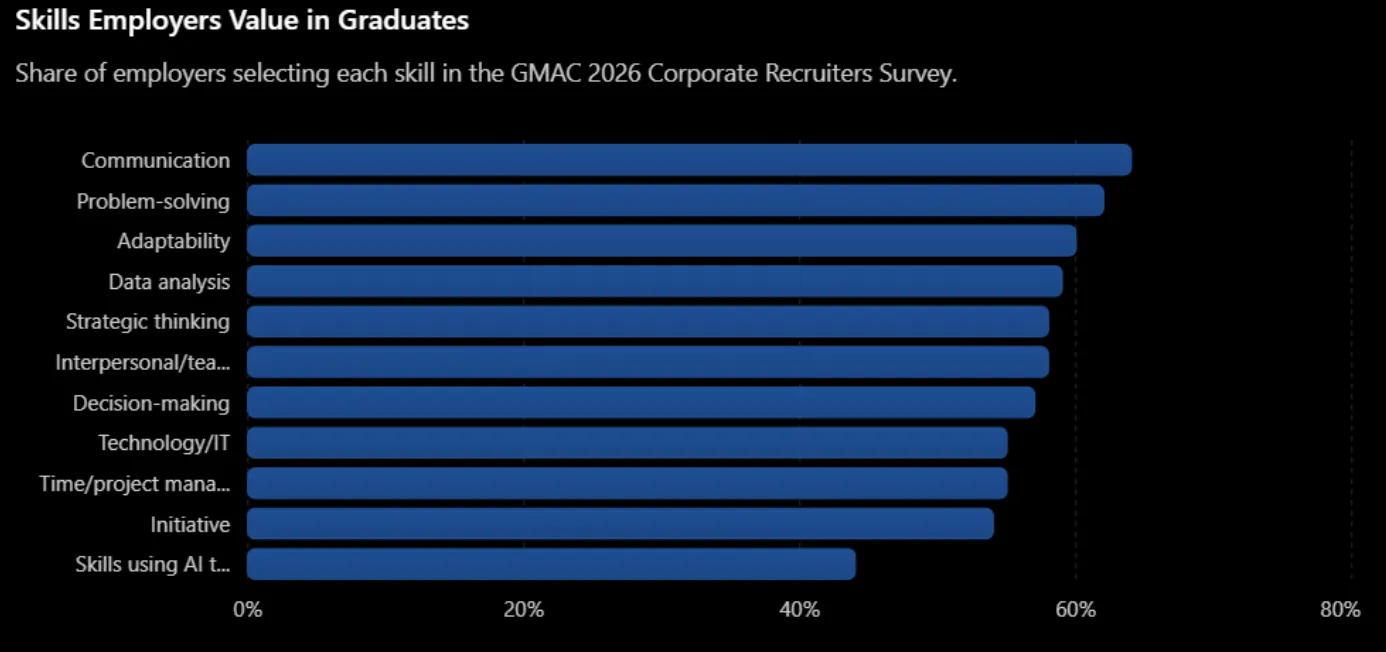
*Source: GMAC 2026 Corporate Recruiters Survey. Percentages represent the share of surveyed employers selecting each skill. *
The finding is important because it puts AI skills into context. Employers are not simply looking for graduates who know how to operate an AI chatbot. They are also looking for people who can communicate ideas, solve problems, interpret information and adapt to changing situations.
Data Analysis Has Also Moved Sharply Up the List
This section explains why AI skills are being accompanied by stronger demand for graduates who can understand and interpret data.
Data analysis and interpretation moved from 10th place in 2025 to fourth place in 2026 among the skills employers value when hiring business school graduates. It was selected by 59% of employers in 2026, compared with 42% in the previous year's survey.
Data Analysis Shows One of the Largest Year-on-Year Changes
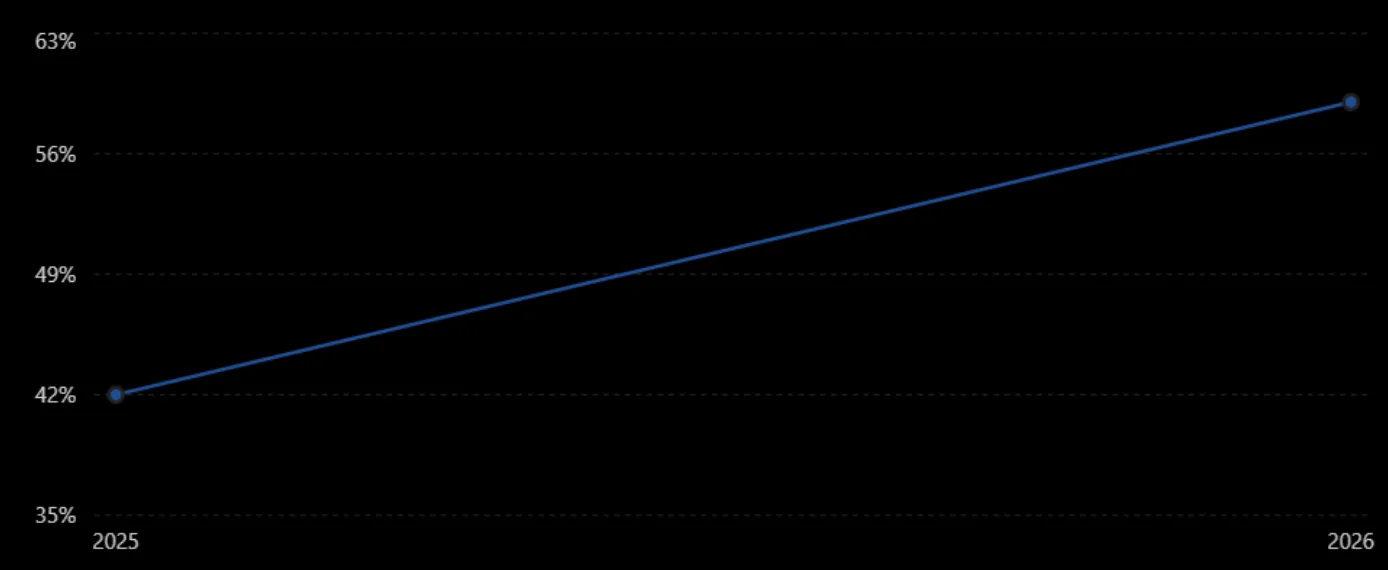
This shift matters as businesses generate and use increasing amounts of data. AI can help process information, but graduates still need to understand what the information means and whether an AI-generated result makes sense.
Want to develop business knowledge alongside data skills? Explore Amrita University Online BBA in Data Analytics.
Employers Want AI to Be Used for Practical Work
Among employers who consider AI capabilities important, 67% want graduate business talent to use AI tools to automate tasks, according to GMAC. Research was the next most frequently identified use, at 59%.
What Do Employers Want Graduates to Use AI For?
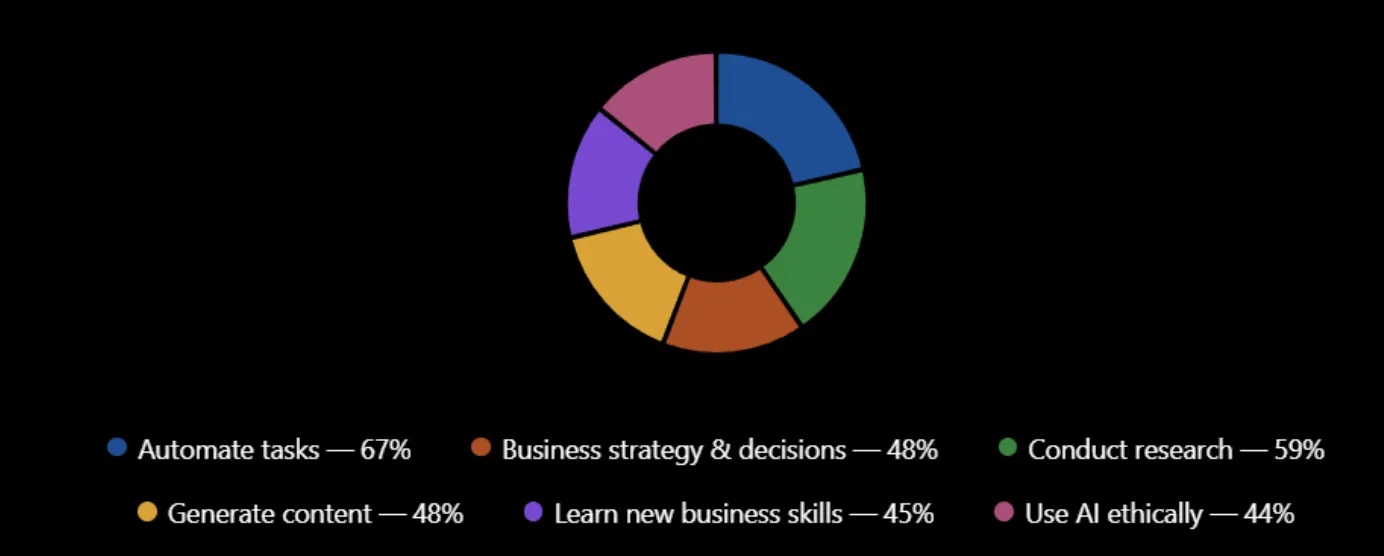
*Source: GMAC 2026 Corporate Recruiters Survey. Figures refer to employers who identified AI capabilities as important. *
This suggests that AI proficiency is increasingly connected to workplace productivity and decision-making.
Interested in this combination of technology + business? Enrol in the Post-Graduate Certificate Programme in Business Analytics and Generative AI today!
Employers See a Gap in AI Readiness
The survey found that at least half of employers considered graduates very well or adequately prepared across most of the skills assessed.
However, AI capabilities were among the areas where employers identified comparatively greater gaps in graduate preparedness. Emotional intelligence, grit and managing human capital were also areas of concern.
This creates a practical takeaway for students: learning an AI tool is only the first step; being able to demonstrate its use in a real project can make the skill easier to understand and communicate to an employer.
One-Third of Employers Say AI Has Already Replaced Some Entry-Level Jobs
GMAC reports that one-third of global employers surveyed said they had already replaced at least some entry-level jobs with AI.
This does not mean that AI is replacing all entry-level employment. Instead, the finding shows that some organisations are already using AI to handle tasks that may previously have been assigned to junior employees.
For graduates, this makes it useful to understand which parts of a role can be automated and where human judgement is still required.
A graduate entering a marketing role, for instance, may encounter AI tools that can generate first drafts, summarise research or analyse campaign data. These applications are also shaping how marketing professionals work, with programmes such as the Executive Certificate Programme in AI-Driven Marketing and Digital Growth focusing on the use of AI in marketing and digital growth.
The employee's role may increasingly involve reviewing outputs, making decisions, understanding customers and communicating recommendations.
Technology Skills Go Beyond AI
The report also examined specific technology capabilities. Among employers who prioritised technology and IT skills, cloud-based technology and data visualisation were among the areas receiving considerable attention, alongside statistical analysis, programming and database tools.
AI is only one part of the technology skill set highlighted by the survey. GMAC reports that technology/IT skills were cited by 55% of employers as important in 2026.
This means students interested in technology-driven careers can think beyond individual AI applications and develop broader digital skills.
Find out if your current skills match the expectations of your target career with Skill Gap Analyzer →
Key Takeaways
The findings suggest that students should build AI literacy alongside data analysis, problem-solving and communication skills.
-
Learn AI tools: Understand how AI can support research, automate tasks and improve workflows.
-
Build data skills: Learn to interpret data, identify trends and assess AI-generated results.
-
Strengthen problem-solving: Practise analysing problems and developing practical solutions.
-
Improve communication: Develop writing, presentation, verbal communication and active listening skills.
-
Stay adaptable: Keep learning as AI tools and workplace requirements change.
-
Build practical projects: Apply AI skills to projects that demonstrate real-world outcomes.
AI Skills Are Becoming Part of a Larger Graduate Skill Set
The main takeaway from the GMAC report is that AI proficiency is becoming more relevant, but employers continue to value the human and analytical skills needed to use technology effectively.
The 2026 GMAC Corporate Recruiters Survey shows that AI tool skills, data analysis and technology/IT skills have gained importance over the previous year. At the same time, communication, problem-solving and adaptability remain highly valued by employers.
The report also indicates that employers expect AI tool skills to become the most important skill area for business school graduates over the next five years, alongside strategic thinking.
Unsure which skills and certifications you need for your career? Get a personalised AI Career Roadmap to plan your next steps.
For students and graduates, the message is therefore broader than simply learning AI tools. The emerging workplace skill set combines AI literacy, data understanding, problem-solving, communication and adaptability.
As AI becomes part of more workplace processes, knowing how to use the technology—and knowing when to question, interpret and communicate its output—can become an increasingly relevant part of graduate preparation.