

5 Skills Most Mechatronics Engineer Aspirants Are Missing (And Don’t Know It)
 Avisha Das14 Oct, 2026
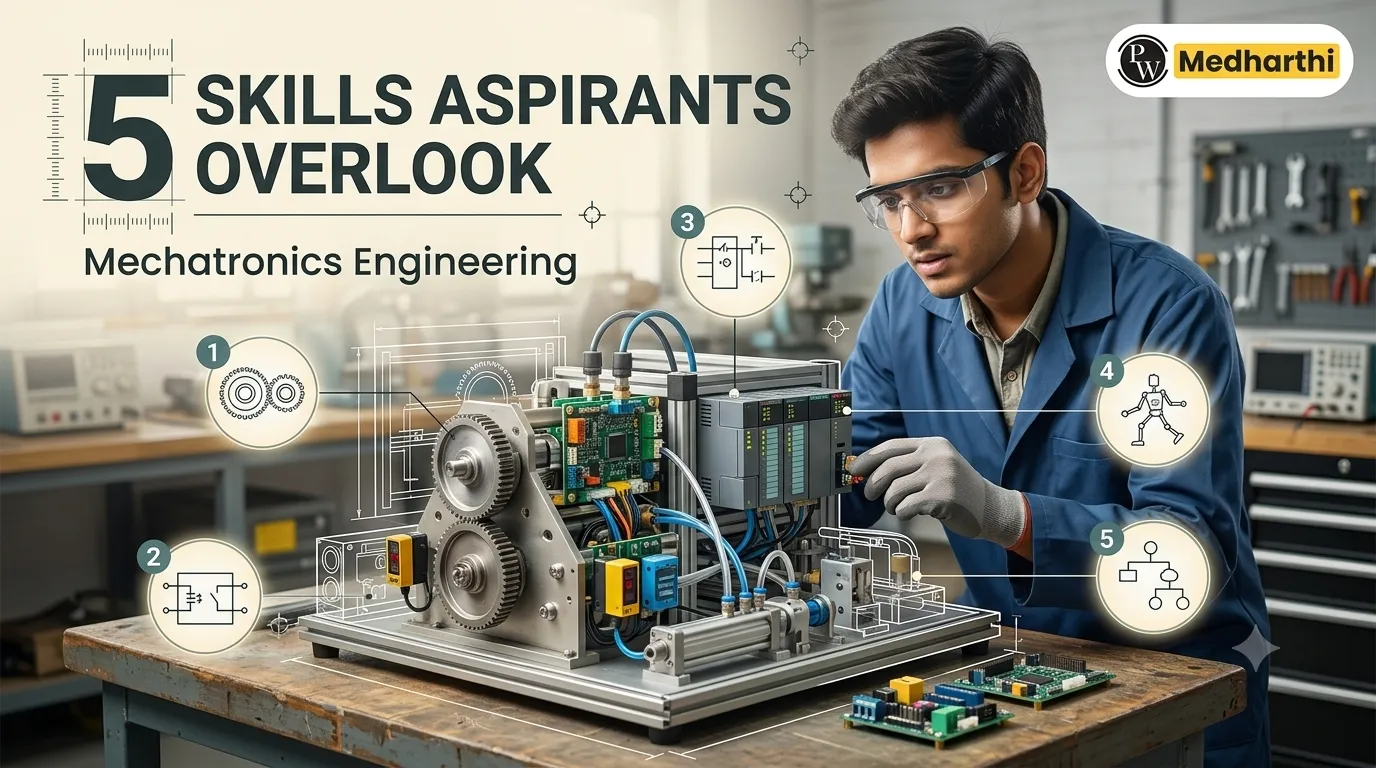
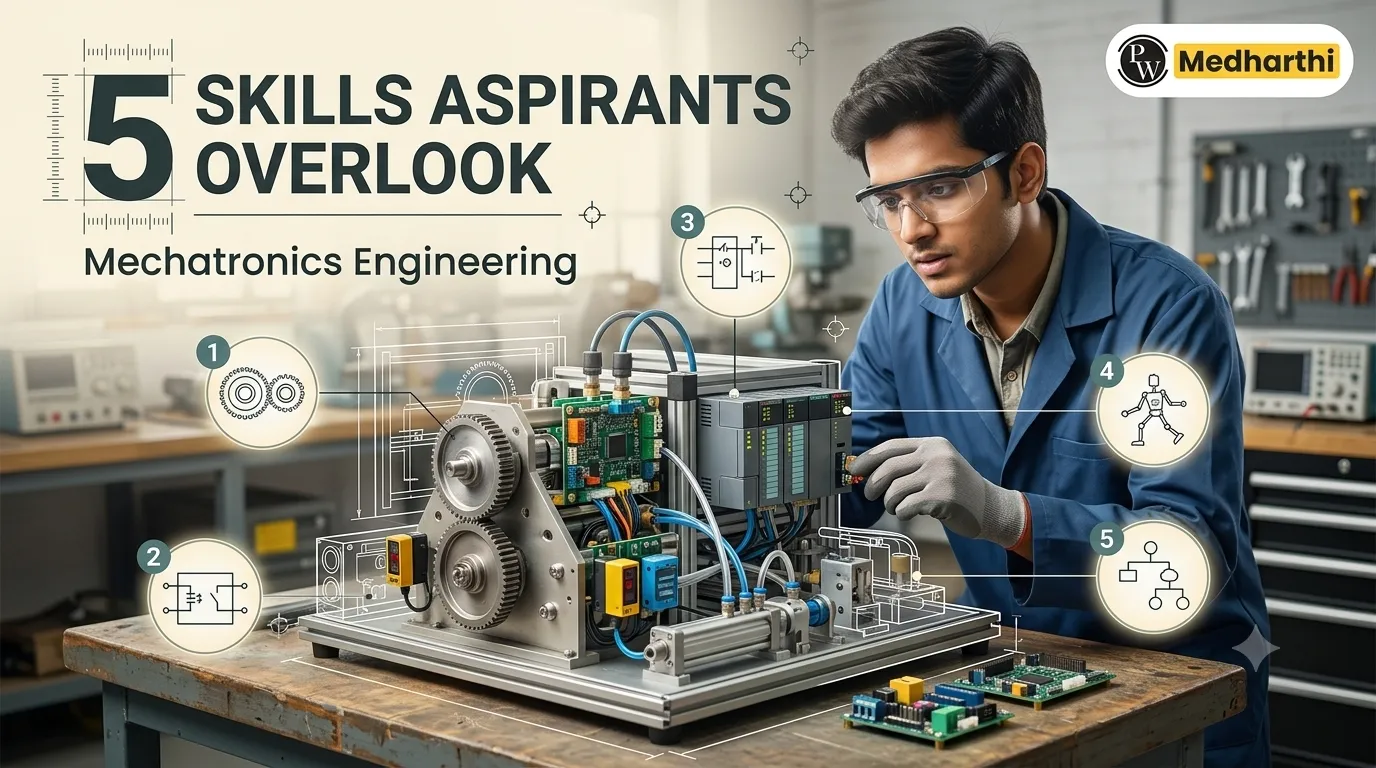
A robotic arm can have powerful motors, accurate sensors and carefully written code, yet still fail to complete a task correctly. Identifying the problem requires more than theoretical knowledge; it calls for practical skills in troubleshooting, system integration and performance testing. For aspiring mechatronics engineers, recognising these skill gaps early can help them prepare for the demands of real-world robotics work.
Take this quick self-check: How confident are you about connecting hardware to software, programming controllers, diagnosing sensor faults, understanding control systems and testing a complete machine?
-
5 out of 5: You have a foundation worth testing through practical projects.
-
3–4 out of 5: Identify the areas where you need more practice.
-
0–2 out of 5: Start with the fundamentals and build your skills step by step.
This is a reflection exercise, not a formal assessment of job readiness. Before choosing a Robotics Online Degree, explore these five essential skills to identify what you know, what you need to practise and how to prepare for your target role.
1. Systems Integration Skills
A mechatronic system combines mechanical components, electrical circuits, sensors, actuators, and software to perform a task. Understanding each component separately is useful, but engineers must also know how these parts interact.
Consider a robotic arm designed to lift an object. The motor may function correctly, yet the arm might struggle because of an unsuitable gear ratio, excessive friction, insufficient power, or an incorrect load calculation.
The skill gap: Knowing individual components without understanding how their interactions affect the complete system.
How to develop this skill:
-
Draw a system diagram showing how sensors, controllers, motors, and mechanical parts connect.
-
Build a small motor-controlled project and identify the role of each component.
-
Learn how to calculate load requirements and assess motor specifications.
-
Test how changing one component affects the performance of the complete system.
-
Practise identifying compatibility issues before assembling components.
Practical challenge: If a robotic arm cannot lift its intended load, list three possible causes before deciding to replace the motor. This exercise encourages you to investigate the complete system rather than make assumptions.
Want to Apply Your Robotics Knowledge to Real-World Systems? Explore PW Medharthi’s AI-Driven Robotics: Design, Intelligence and Automation programme to learn more about robotics, intelligent systems, and automation.
2. Embedded Programming Skills
Embedded programming involves writing code that interacts directly with physical hardware. Controllers must read inputs, process information, operate connected components, and respond to changing conditions.
For example, an automated conveyor belt may need to stop when a package reaches a sensor. If the controller processes the signal incorrectly or responds too slowly, the package could move beyond the intended stopping point.
The skill gap: Knowing programming syntax without understanding how code behaves when connected to real hardware.
How to develop this skill:
-
Practise reading digital and analogue inputs from sensors.
-
Programme microcontrollers to operate motors and other components.
-
Learn conditional statements, timers, and basic communication protocols.
-
Debug problems involving code, wiring, controllers, and connected devices.
-
Add basic fault-handling logic for disconnected sensors or unexpected inputs.
Practical challenge: Create a sensor-based motor-control project. Test what happens when the sensor detects an object, misses it, or produces inconsistent readings. Record the results and adjust the code.
The objective is to understand how software controls physical devices, including what happens when the system behaves unexpectedly.
Interested in Building Skills for AI-Powered Engineering? Explore AI and ML programmes from IIT Patna to understand how artificial intelligence and machine learning can be applied across technical fields.
3. Sensor Calibration and Hardware Troubleshooting Skills
Sensors help machines measure distance, position, temperature, pressure, and other physical conditions. However, their readings can be affected by electrical noise, incorrect positioning, poor calibration, environmental conditions, and faulty connections.
Imagine an obstacle-avoidance robot that suddenly changes direction even though the obstacle has not moved. The issue may not be the robot's movement algorithm. The sensor could be sending inconsistent measurements that cause the controller to react incorrectly.
The skill gap: Assuming that sensor readings are always accurate instead of investigating abnormal results.
How to develop this skill:
-
Record measurements: Take several readings under the same conditions.
-
Compare values: Check whether the readings fall within an expected range.
-
Inspect the hardware: Examine wiring, power supply, and sensor placement.
-
Identify patterns: Investigate whether inconsistent readings occur at particular distances or under specific conditions.
-
Verify the correction: Repeat the measurements after adjusting.
Practical challenge: Take 20 readings from a distance sensor while an object remains stationary. Compare the results and investigate any significant variation before deciding how the robot should respond.
This skill helps engineers identify the source of a problem instead of replacing components without sufficient evidence.
4. Control Systems and Feedback Skills
Control systems help machines achieve desired outputs and respond to changes in their operating conditions. Engineers use control principles to manage movement, speed, position, and other measurable variables.
An open-loop system issues commands without using measured output to correct the result. A closed-loop system uses feedback to compare actual performance with a target and adjust its response.
For example, a robotic arm may be instructed to rotate through a specific angle. Changes in load or friction can affect its movement. A feedback controller uses position measurements to help reduce the difference between the target and actual positions.
The skill gap: Knowing how to command a machine without understanding feedback, error correction, and system response.
How to develop this skill:
-
Understand open-loop and closed-loop control systems.
-
Learn about feedback, error measurement, and stability.
-
Study overshoot, response time, and steady-state error.
-
Explore the basics of proportional, integral, and derivative (PID) control.
-
Use simulations to observe how different control settings affect machine behaviour.
Practical challenge: Simulate a motor-positioning system and adjust its control parameters. Observe whether the motor reaches the target quickly, overshoots it, or takes too long to settle. Compare the results to understand how control settings influence performance.
These skills are useful in robotic positioning, motor-speed regulation, and industrial automation, where predictable machine behaviour is essential.
Looking to Connect Robotics with Industrial Automation? Explore PW Medharthi’s Advanced Certificate Programme in AI-Driven Supply Chain and Industry to learn about applications related to automation and smart manufacturing.
5. System Testing and Performance Optimisation Skills
A prototype that works during a demonstration is not necessarily reliable enough for regular operation. Its performance may change when the workload increases, the environment changes, or the system runs continuously.
Imagine an automated sorting machine that correctly classifies ten objects. What happens when it processes 500 objects of different sizes under changing lighting conditions? Without repeatable testing, important weaknesses may remain unnoticed.
The skill gap: Treating one successful demonstration as proof that a system is reliable.
How to develop this skill:
-
Define measurable performance targets before testing.
-
Repeat tests under consistent conditions.
-
Record accuracy, response time, and error rates.
-
Document code changes, design modifications, and test results.
-
Test the system after every major correction.
-
Compare results to verify whether an adjustment has improved performance.
Use the following table to decide what to measure when testing a project.
|
Test area |
What to measure |
|
Accuracy |
Does the system achieve its intended result? |
|
Speed |
How long does it take to complete a task? |
|
Reliability |
Does it produce consistent results across repeated trials? |
|
Error rate |
How often does it make an incorrect decision or movement? |
|
Fault response |
How does it respond when a sensor or component fails? |
Practical challenge: If a sorting robot misclassifies objects, record the number of errors across 50 trials. Change one factor, such as sensor position, and repeat the test. Compare the results to determine whether the adjustment improved accuracy.
Testing and documentation help engineers move beyond building a working prototype to understanding its limitations and improving its performance.
Not Sure Which Skills You Should Learn Next? Use PW Medharthi’s Robotics Online Degree skill gap analyser to assess your current abilities, identify areas for improvement, and plan your next learning steps.
How to Use PW Medharthi’s Robotics Online Degree Skill Gap Analyser to Plan Your Learning
A Robotics Online Degree skill gap analyser can help you compare your current abilities with the competencies required for your target role. If a dedicated assessment tool is unavailable, the checklist above can serve as a starting point for evaluating your skills.
The next step is to turn your assessment into a practical learning plan.
-
Choose a priority skill: Identify the area that currently limits your progress.
-
Set a specific goal: For example, programme a controller to read sensor data and operate a motor.
-
Build a project: Apply the concept instead of relying only on theoretical lessons.
-
Measure your progress: Record accuracy, response time, and recurring errors.
-
Review and repeat: Make improvements and test the system again.
For example, if systems integration is your weakest area, start with a project that connects a sensor to a controller and uses the controller to operate a motor. Once the basic setup works, introduce a new condition and observe how the system responds.
Learners interested in industrial automation, smart manufacturing, and AI applications can also explore relevant programmes offered by PW Medharthi, including its Advanced Certificate Programme in AI-Driven Supply Chain and Industry 4.0. Review the curriculum to determine whether it aligns with your interests and career goals.
A skill-gap assessment should do more than produce a score. It should help you decide what to learn next, which projects to undertake, and how to measure your progress.
Ready to Turn Your Skill Gaps into Learning Goals? Explore relevant programmes on PW Medharthi and compare their curriculum with the skills you want to develop for your target role.
Build the Skills Your Target Role Actually Needs
Mechatronics engineering brings together mechanical design, electronics, programming, sensors, and control systems. Understanding these subjects is important, but applying them together is what helps you solve practical engineering problems.
Start by assessing your current abilities, choose a project that challenges your weakest area, and test your solution under different conditions. Before enrolling in a Robotics Online Degree, compare available learning options with your skill gaps and career goals.
Take the Next Step Towards Your Robotics Career. Identify your strongest skills, work on the areas that need improvement, and explore learning opportunities that align with your interests in robotics, AI, and automation.
The objective is not simply to build a robot that works once. It is to understand why it works, diagnose problems when it fails, and improve its performance reliably.
Key Takeaways
-
Systems integration matters: Mechatronics engineers need to understand how mechanical components, electronics and software work together.
-
Embedded programming is essential: Learn to programme controllers, process sensor inputs and operate hardware through code.
-
Sensor troubleshooting improves reliability: Practise identifying inaccurate readings, faulty connections and calibration issues.
-
Control systems help machines perform accurately: Understand feedback, error correction and basic PID control to improve system behaviour.
-
Testing helps identify performance gaps: Measure accuracy, response time, reliability and error rates instead of relying on a single successful trial.
-
Build projects to strengthen practical skills: Apply theoretical concepts through hands-on exercises, simulations and repeatable tests.
-
Use a skill-gap assessment to plan your learning: Identify weaker areas and compare relevant Robotics Online Degree programmes with your target career requirements.
-
Explore relevant learning opportunities: Check PW Medharthi programmes and their curricula to see whether they align with your interests in robotics, AI and industrial automation.
IIT Bhubaneswar AI ML Courses FAQs
What is the IIT Bhubaneswar AI/ML course?
What makes the IIT Bhubaneswar generative AI course special?
Who can join the IIT Bhubaneswar AI ML courses?
Where can I access the syllabus for the IIT Bhubaneswar AI course?
What is the IIT Bhubaneswar AI course benefiting me in my career?