


Data Analysis Emerges as a Key Skill Across Top MBA Programmes
 Kishor Kumar Bairagi12 Oct, 2026


An MBA can teach you how businesses operate, but what happens when the numbers contradict your assumptions? Sales may be falling despite higher marketing spend, or a product may attract users without turning them into paying customers. In such situations, knowing business concepts is not enough. You also need to identify what the numbers are telling you and decide what to do next.
That is where Data Analysis becomes relevant for MBA aspirants. LinkedIn’s Top MBA Programmes 2026 report places Data Analysis among the three most common skills associated with graduates of 63 out of 100 ranked MBA programmes.
The finding raises an important question for future managers: how can analytical skills help you move from understanding a business problem to making a better decision?
Data Analysis Features Among the Most Common Skills Across Top MBA Programmes
What do graduates of leading MBA programmes have in common? Their career paths may differ, but the skills associated with them can offer clues about what business education prepares students to do.
LinkedIn’s report examines MBA programmes through factors linked to alumni career outcomes, including career progression, hiring demand, leadership potential and professional networks. Its findings highlight both the skills associated with graduates and the job titles they commonly hold.
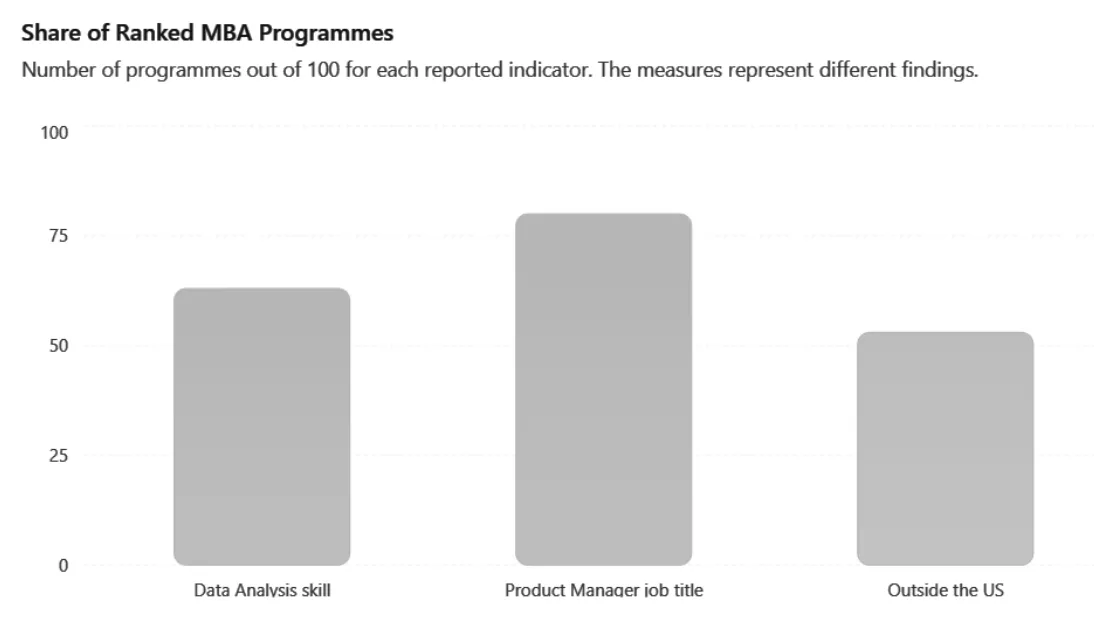
Data Analysis appears among the three most common skills associated with graduates of 63 programmes, while Product Manager appears among the three most common job titles associated with graduates of 80 programmes. The report also includes 53 programmes located outside the United States.
The key question is not simply whether Data Analysis appears in the rankings. It is where this skill could make a difference when you are responsible for a business decision.
Why Is Data Analysis Relevant for MBA Aspirants?
Imagine a company whose sales have declined over three months. The marketing team believes its campaigns are underperforming, while the sales team points to changing customer preferences. A manager needs more than assumptions to understand the problem.
By examining sales figures, customer behaviour, campaign performance and regional trends, the manager can identify possible causes and make a more informed decision.
This is where Data Analysis becomes useful in management. It helps professionals interpret business information, assess performance and support decisions with evidence.
Its applications can extend across several business functions:
-
Marketing: Analysing campaign performance, customer behaviour and conversion rates.
-
Finance: Reviewing budgets, costs, revenue and financial performance.
-
Operations: Identifying delays, tracking efficiency and monitoring resource use.
-
Product Management: Understanding user behaviour, product performance and customer feedback.
-
Business Strategy: Comparing market trends and evaluating business opportunities.
Data Analysis does not replace business judgement. Instead, it gives managers information they can use to assess options and explain their decisions.
Interested in developing business analytics skills? Explore the Post Graduate Certificate Programme in Business Analytics and Generative AI.
What Does the Finding Mean for MBA Career Opportunities?
The report provides a snapshot of the skills and job titles associated with graduates of leading MBA programmes. It does not establish that Data Analysis alone leads to a particular job, salary or career outcome.
However, the finding suggests that analytical ability is worth considering when preparing for management roles. Professionals may need to review performance reports, interpret business metrics, identify trends and communicate their findings to colleagues.
The goal is not to become a data analyst in every management role. It is to become more confident in using data to understand business problems and evaluate possible solutions.
Which Data Analysis Skills Should MBA Students Develop?
You do not need to begin with advanced coding to understand business data. In many management situations, the first challenge is knowing which figures matter, how to interpret them and what they can, and cannot, tell you.
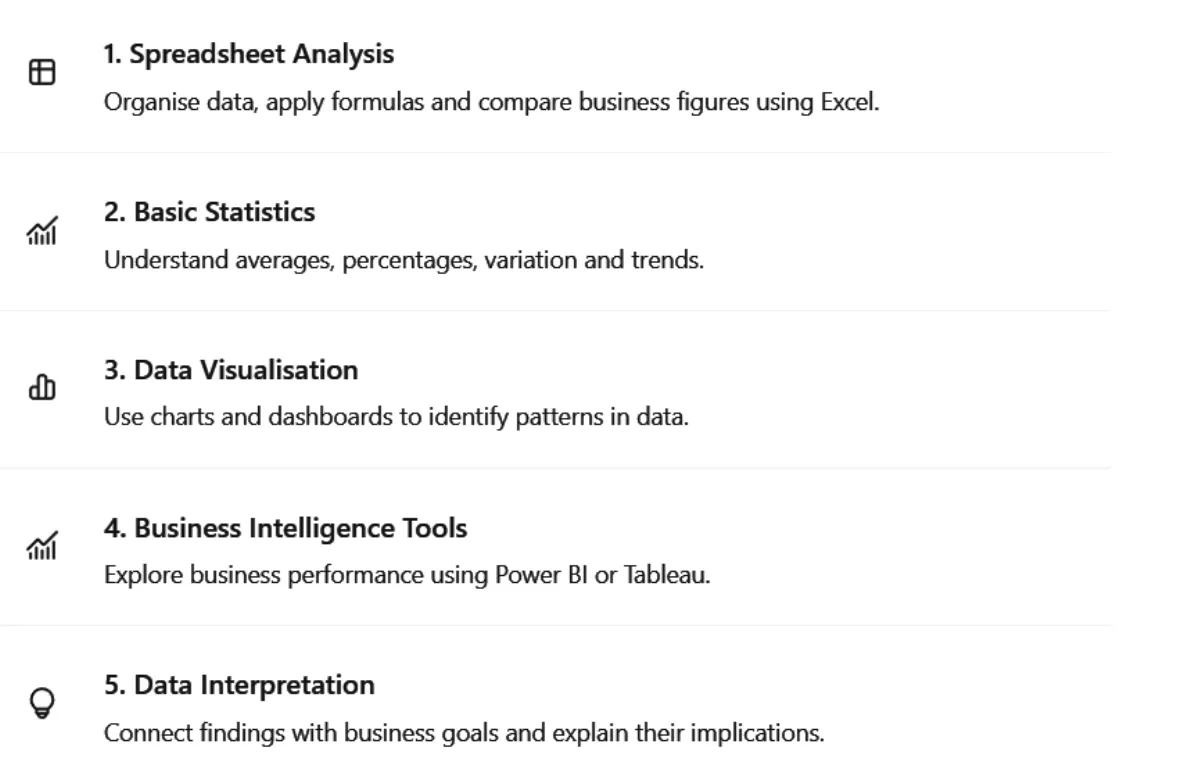
But there is a catch: knowing how to use a tool does not automatically mean you know how to solve a business problem. A chart can show that one product sells better than another, but it may not explain whether the difference comes from pricing, demand, marketing or availability.
Looking to build analytical skills for business roles? Explore the Post Graduate Certificate Programme in Business Analytics and Generative AI by PW Medharthi.
How Can MBA Aspirants Apply Data Analysis in Practice?
Can you crack a business case using data? Try these 5 mini challenges
What if you were the manager of a company facing falling sales, rising costs or unhappy customers? Instead of guessing what went wrong, you could put your analytical skills to the test with these five mini challenges.
-
Play detective with a dataset: Explore sales, marketing or financial figures to spot unusual patterns and uncover clues behind a business problem.
-
Turn numbers into a dashboard: Use charts and performance indicators to make confusing spreadsheets easier to understand at a glance.
-
Take on a business case: Investigate a hypothetical company problem, identify the metrics that matter and recommend your next move.
-
Pitch your findings: Present your analysis as if you were explaining your recommendation to a manager who needs a clear answer, not a page full of numbers.
-
Build your project portfolio: Document the question, your analysis, key findings and recommendations to show how you approach business problems.
The interesting part is that there may be more than one possible explanation for a business problem. Your task is to use the available evidence to support your reasoning, explain what you found and acknowledge what the data cannot tell you.
Think like a manager, investigate like an analyst, and present your findings like a decision-maker.
Data Analysis Remains One Part of the MBA Skill Set
LinkedIn’s Top MBA Programmes 2026 report also identifies Business Development, Strategic Planning and Stakeholder Management among the common skills associated with graduates of ranked programmes. These skills complement analytical ability in different ways:
-
Data Analysis helps you investigate problems and interpret evidence.
-
Strategic Planning helps you assess options and decide what to do next.
-
Business Development helps you identify opportunities for business growth.
-
Stakeholder Management helps you work with people involved in or affected by a decision.
Key takeaway: Data can help you identify the problem, but business judgement and people skills help you decide what to do about it. The right mix depends on whether you want to work in finance, marketing, consulting, operations or product management.
What Does LinkedIn’s 2026 Report Mean for MBA Aspirants?
If you are planning an MBA, the report offers a useful signal about the skills associated with graduates of ranked programmes. Data Analysis features among the three most common skills associated with graduates of 63 out of 100 programmes. This does not guarantee a particular job or salary, but it gives you a reason to consider analytical skills as part of your preparation.
You can start with spreadsheets, basic statistics, data visualisation and data interpretation. Then put these skills to use through mini projects that involve investigating a business problem, identifying patterns and presenting a recommendation.
Key Takeaways
-
Data Analysis is worth developing: It features among the three most common skills associated with graduates of 63 ranked MBA programmes.
-
Tools are only the starting point: Learn to interpret the results and connect them with business questions, rather than simply creating charts.
-
Combine skills for stronger decisions: Communication, critical thinking, strategic planning and stakeholder management complement analytical ability.
-
Practise with real-world problems: Use datasets, dashboards and business cases to demonstrate how you approach decisions.
-
Choose skills that match your goals: The analytical knowledge you need may differ across finance, marketing, consulting, operations and product management.
The aim is not simply to work with numbers. It is to understand what the information reveals about a business and how it can support better decisions.