
From Prompt Engineering to Agentic AI: How India's New AI Qualifications Are Expanding the Course Landscape
 Avisha Das15 Oct, 2026
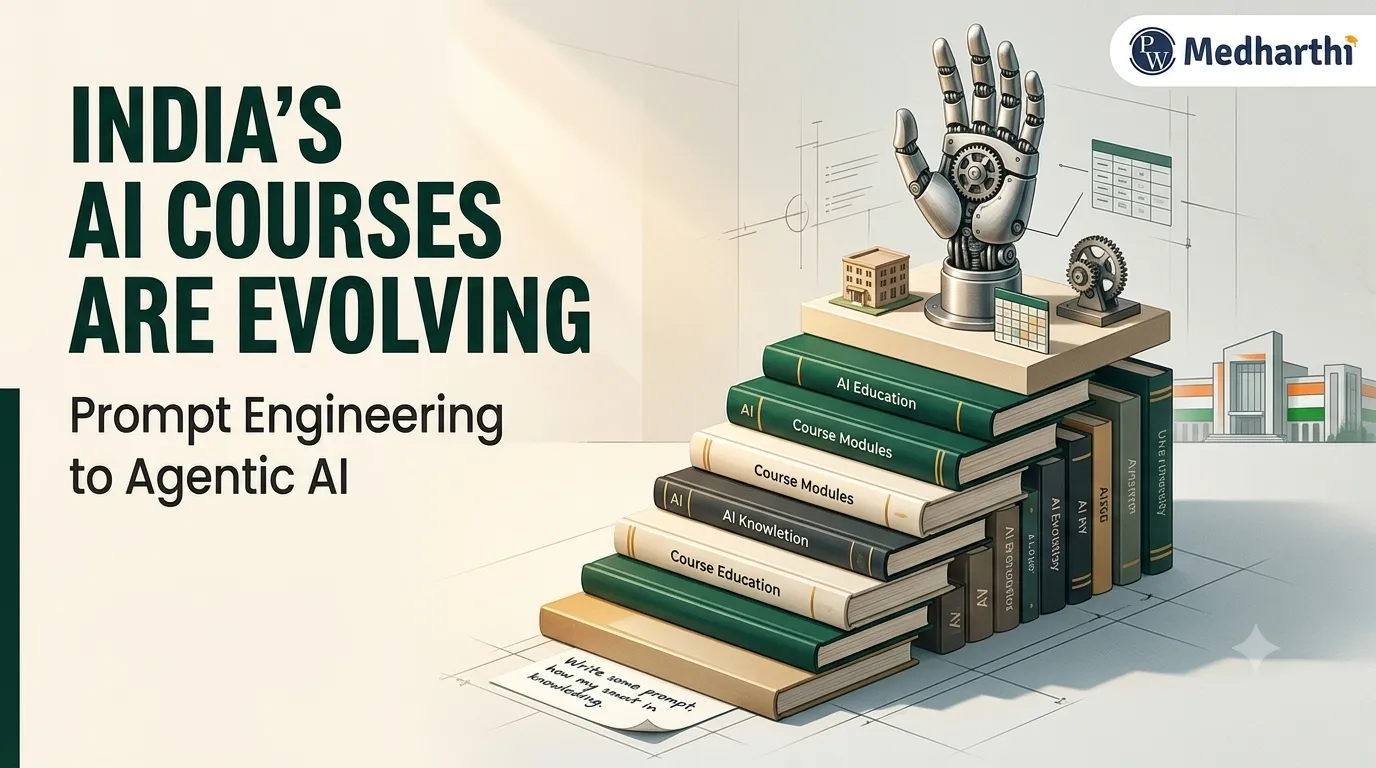
India's official AI skilling ecosystem is expanding across qualifications, literacy programmes and vocational training.
A written reply in the Lok Sabha, released by PIB on 10 August 2026, outlines this growing landscape, covering 116 AI and Machine Learning qualifications under NCVET, the 50-course SOAR AI literacy programme, AI-related job roles under PMKVY 4.0, and new AI trades introduced in Industrial Training Institutes (ITIs).
The reply, provided by Shri Jayant Chaudhary, Minister of State (Independent Charge) in the Ministry of Skill Development and Entrepreneurship (MSDE), also points to gaps in outcome measurement. Based on the release and all four annexures, the analysis explores the qualifications and programmes currently on offer, what the available data reveals about participation, and the factors you should consider when choosing your next AI course.
116 Qualifications Later: What "AI-Ready" Now Means on Paper
India’s AI skilling ecosystem now includes 116 NSQF-aligned and NSQC-approved qualifications, National Occupational Standards (NOSs) and micro-credentials related to Artificial Intelligence and Machine Learning, according to the Ministry of Skill Development and Entrepreneurship.
These offerings cover more than generative AI tools, extending to technical development, automation and responsible AI practices.
The range of subjects mentioned in the release reflects the different skills involved in working with AI, from using AI applications to developing systems and understanding their security and governance requirements.
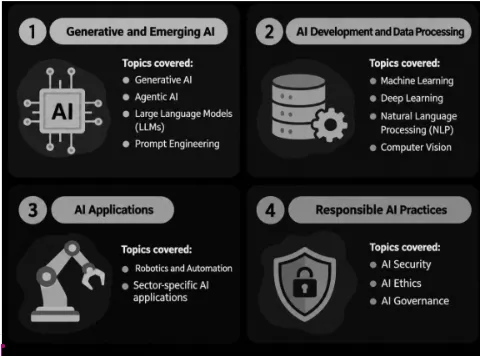
The key point is that AI skilling is not limited to one career path. Before selecting a course, check its learning outcomes, practical components, assessment requirements and relevance to the role you want to pursue.
SOAR: The AI Literacy Ladder, From 4 Courses to 50
"Fully online, self-paced and credit-linked: AI literacy without relocating."
Skilling for AI Readiness (SOAR) was launched by NCVET to promote AI literacy. It began with four foundational courses: AI to be Aware, AI to Acquire, AI to Aspire and AI for Educators. It has since been expanded to 50 AI and AI-application-oriented NSQF-aligned courses covering AI for jobs, workplace productivity, sector-specific applications and inclusivity.
Courses are delivered through the Skill India Digital Hub (SIDH) by NCVET-recognised Awarding Bodies. The release highlights that the fully online, self-paced format lets youth, educators and other learners, including those from rural and semi-urban areas, earn nationally recognised, credit-linked AI competencies.

Explore the best AI courses and start building in-demand skills today. Visit AI Course
PMKVY 4.0's AI Funnel: From Enrolment to Certificate
"Enrolment gets you in the door. Assessment decides who walks out certified."
PMKVY 4.0 is described in the release as a demand-driven, industry-aligned scheme, with job roles developed in consultation with industry and Sector Skill Councils across sectors such as IT-ITES, Telecom and Life Sciences.
Training is delivered through AICTE-affiliated colleges, private universities and colleges, engineering colleges, ITIs, NIELIT centres, PMKKs, Skill Universities, Institutes of National Importance and State Government universities and colleges. It has also been extended to rural, semi-urban, aspirational and underserved districts.
Annexure IV tracks AI job roles stage by stage, as of 30.06.2026:
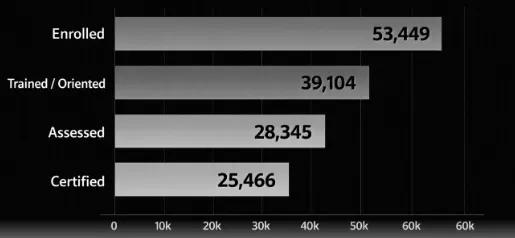
Reading note: the release text describes 53,449 as "trained/oriented", while Annexure IV lists the same figure under "Enrolled" and shows 39,104 as trained/oriented. This article follows the annexure table.
Inside the ITIs: AI Reaches the Workshop Floor
"From a 7.5-hour taster to a full year, vocational AI now comes in three sizes."
The Directorate General of Training (DGT) has introduced AI into vocational training through three offerings for ITI trainees:
-
Artificial Intelligence Programming Assistant (AIPA): 1 year
-
Generative AI Course: 240 hours
-
AI Micro-Credential: 7.5 hours
The compulsory Employability Skills curriculum has also been revised to include modules on AI and Green Skills.
Industry partnership. In collaboration with Microsoft and the Edunet Foundation, the AIPA course under the Craftsmen Training Scheme (CTS) ran at 19 National Skill Training Institutes (NSTIs) in 2024-25 with an intake capacity of 504, and was extended to 23 NSTIs in 2025-26 with an intake capacity of 600.
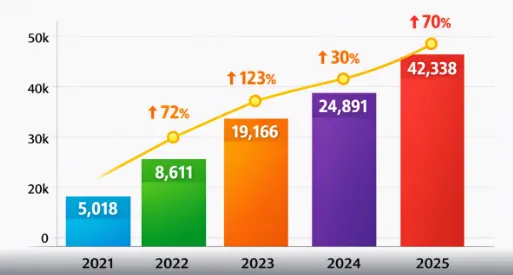
Enrolment in new-age courses. Annexure II shows trade-wise enrolment in ITIs and NSTIs under CTS from 2021 to 2025:
A closer look at selected trades:
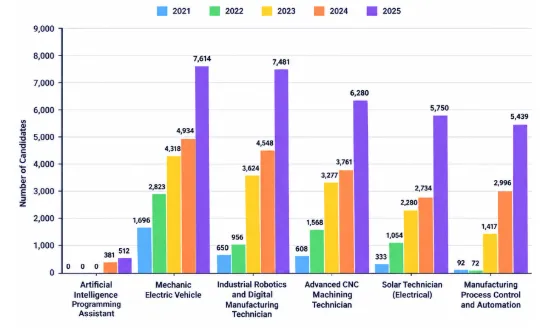
The 32 new-age courses listed in Annexure I also include Data Annotation Assistant, Cyber Security Assistant, Industrial Robotics and Digital Manufacturing, Software Testing Assistant, Drone Technician and Semiconductor Technician, among others.
Interested in becoming an AI Engineer? Explore the latest AI Engineer vacancy details and eligibility here. View AI Engineer Job
Which AI Job Roles Are Getting Certified?
"Machine Learning Engineer leads the certified list; Data Quality Analyst leads enrolment."
Qualifications show what exists on paper, but job roles show what people are actually being trained to do. Under PMKVY 4.0, the AI roles were built in consultation with industry and Sector Skill Councils to match evolving workforce requirements across sectors such as IT-ITES, Telecom and Life Sciences. Certification comes only after assessment, so the certified column is the one that shows who has completed the full route.
Annexure IV lists 20 AI job roles under PMKVY 4.0. The table below is sorted by number certified:
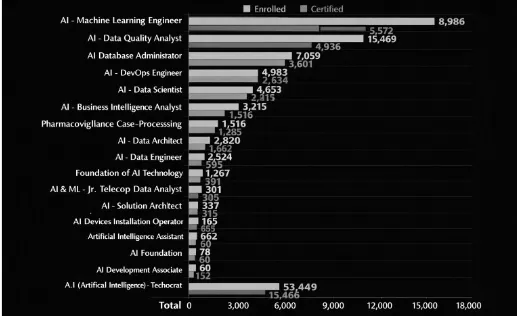
Two things are worth noticing. First, the list is heavily data-oriented: data quality, data science, data engineering, databases and business intelligence all appear. Second, "AI jobs" are not only about coding. The pharmacovigilance role shows AI tools entering life-sciences work as well.
What the Release Doesn't Say (and Why You Should Know)
"Schemes are 'demand-driven and industry-aligned', but no formal demand or workforce-gap assessment exists yet."
The reply states plainly that a specific assessment of demand for AI-related skills and the current workforce gap has not been done. It adds that the schemes are designed on a demand-driven and industry-aligned basis, with job roles identified in consultation with industry and Sector Skill Councils.
That distinction matters. The figures in this article describe supply: how many qualifications exist, how many people enrolled and how many were certified. They do not, on their own, tell us how many AI jobs are waiting or how enrolment translates into employment.
The Bottom Line
"India now has an AI course for almost every starting point. The harder question is which one fits where you want to go."
From 116 qualifications on paper to 50 SOAR courses, an AI-related job-role pipeline under PMKVY 4.0 and AI trades inside ITIs, the course landscape has widened across levels, from a 7.5-hour micro-credential to degree-level study.
Find more career opportunities across sectors and apply to jobs matching your qualifications. View Job Updates
Key takeaways
-
The NCVET ecosystem now has 116 NSQF-aligned and NSQC-approved qualifications, National Occupational Standards (NOSs) and micro-credentials related to AI and Machine Learning.
-
Domains covered include Generative AI, Agentic AI, Large Language Models (LLMs), Prompt Engineering, AI Security, AI Ethics and AI Governance.
-
SOAR (Skilling for AI Readiness) has grown from 4 foundational courses to 50, with 4,96,426 learners enrolled and 98,576 certified as of 22.07.2026.
-
Under PMKVY 4.0, 25,466 candidates were certified in AI-related job roles as of 30.06.2026.
-
A list of 32 new-age courses, including AI-related trades, is running across ITIs and NSTIs.




