

Are Entry-Level Jobs Disappearing Because of AI? What the WEF Report Reveals
 Avisha Das23 Oct, 2026


Your first job is where you learn to turn classroom knowledge into workplace skills, handle real projects and gain the experience employers expect. But what happens when AI can do many of the tasks that freshers once handled to learn the ropes? As companies automate routine work, the traditional starting point for many careers could begin to change.
The World Economic Forum’s June 2026 report, Artificial Intelligence and the Future of Entry-Level Work: A Framework for Safeguarding and Reinventing Early Career Pathways, developed with PwC, examines how AI is reshaping early-career opportunities. It explores how employers can rethink entry-level roles to ensure freshers still have opportunities to gain practical experience, build essential skills and progress in their careers.
THE BIG TAKEAWAY
AI is changing entry-level work, but exposure does not automatically mean job loss. The bigger risk is that automating routine tasks could also remove the opportunities through which freshers gain experience and develop professional judgement.
What Does the WEF Report Actually Say About Entry-Level Jobs?
Entry-level opportunities are under pressure in some AI-exposed fields, but the report does not predict the disappearance of all entry-level jobs.
The report points to three developments: hiring slowdowns in some AI-exposed occupations, changing expectations of junior employees, and uncertainty about how newcomers will gain experience if routine work is automated.
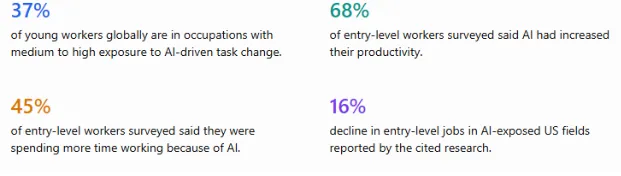
One finding cited in the report is a 16% decline in entry-level jobs in AI-exposed fields in the United States since late 2022, based on research by Erik Brynjolfsson and colleagues. However, declines in entry-level job postings began nearly a year before ChatGPT was released in November 2022.
That timing makes it difficult to attribute the entire slowdown to generative AI. Economic uncertainty, cost pressures and cautious hiring decisions also influence employers.
The Report’s Central Numbers
Which Industries Face Greater Exposure to AI-Driven Change?
AI exposure varies by industry and reflects how readily AI can affect the tasks involved, not whether an entire sector will lose jobs.
The WEF report identifies Financial and Insurance Activities, Information and Communication, Professional, Scientific and Technical Activities, Real Estate, and Education among the more exposed sectors. Many roles in these fields involve information processing, analysis and documentation that AI can assist with or perform.
By contrast, Agriculture, Construction and Accommodation and Food Services are comparatively less exposed in the report’s analysis. This does not mean these sectors are immune to technology or guaranteed to grow. Their tasks simply differ in how readily current AI capabilities can affect them.
AI is changing industries at different rates. Explore the Advanced Certificate Programme in AI-Driven Supply Chain and Industry course to understand whether AI applications in these fields align with your career goals.
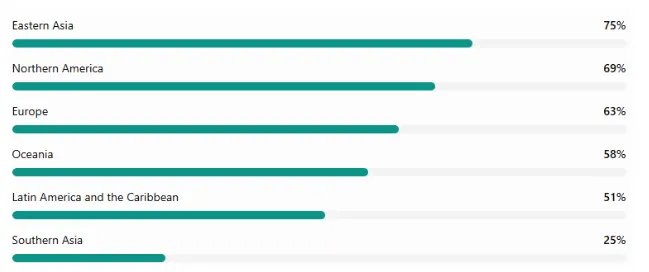
Young Workers in Occupations With Medium to High AI Exposure
A USEFUL WAY TO READ THE SIGNAL
Exposure is not the same as job loss. An occupation can be highly exposed because AI changes how its tasks are performed, even when human judgement, accountability, communication or specialist knowledge remain necessary.
Why Are Entry-Level Roles Particularly Vulnerable?
Automating routine tasks could reduce not only some vacancies but also the everyday learning opportunities that help freshers build expertise.
Entry-level jobs often involve repetitive or administrative tasks that help new employees learn how an organisation works. Preparing initial research, checking documents, drafting routine communications, updating records and writing basic code can all provide early opportunities to practise professional skills.
AI can now assist with many of these activities. Employers may need fewer people for some tasks or expect junior employees to complete more work in less time.
The report highlights three connected challenges:
-
Fewer traditional entry points: Automating routine tasks without redesigning junior roles could reduce opportunities for candidates with limited experience.
-
A weaker learning curve: If AI performs tasks that once helped newcomers build expertise, employers must find other ways to develop practical knowledge and judgement.
-
Higher expectations from day one: New hires may need to use AI tools effectively, assess their outputs and contribute to more complex work earlier in their careers.
The challenge is that speed alone does not prove an employee understands the work or can identify an incorrect result.
Knowing your subject may not be enough when AI can handle routine tasks. Explore the AI and ML Programme by IIM Kashipur to assess whether it fits your learning needs and career goals.
Is AI Making Employees More Productive or Simply Increasing Work?
KEY TAKEAWAY: Productivity gains do not automatically mean lighter workloads or better learning opportunities.

The report describes employers using the time saved by AI in different ways. Some redirect it towards analysis, problem-solving and stakeholder engagement. Others encounter duplicated outputs, superficial analysis or greater dependence on AI-generated content without adequate review.
THE IMPORTANT DISTINCTION
If AI removes repetitive tasks while companies preserve opportunities to learn, new employees could take on meaningful work sooner. If organisations focus only on output and cost reduction, workers may have fewer chances to develop the judgement that more senior roles require.
The report also points to a gap between AI adoption and job redesign: only 16% of organisations reported fully redesigning roles, processes and operating models to integrate AI effectively. Simply adding AI tools to existing workflows is not the same as rethinking how people should work alongside them.
What Happens If Companies Stop Hiring Beginners?
Cutting entry-level hiring without creating new learning pathways could leave companies with fewer experienced workers to promote or hire later.
Many organisations develop future specialists and leaders by hiring people into junior roles and allowing them to learn through practice. If companies reduce entry-level hiring too aggressively, they may weaken the same talent pipeline they will later rely on to fill experienced positions.
The report also finds that 23% of CEOs surveyed believe their current organisational structure is suboptimal and may be constraining performance. Three-quarters of leaders expect significant realignment of entry-level roles as AI adoption progresses. These findings indicate that companies are reconsidering how work is organised, but do not establish that all such changes will lead to job cuts.
Career progression may also become less dependent on moving through fixed job titles. Projects, cross-functional work and demonstrated skills could create new routes forward, provided organisations make learning opportunities and advancement criteria clear.
If traditional entry-level routes change, how will you plan your next move? Use the PW Medharthi Career Roadmap Generator to map learning priorities based on your career goal and current skills.
What Skills Will Help Freshers Stay Competitive in an AI-Enabled Workplace?
Freshers do not all need to become AI engineers, but they do need relevant domain knowledge, practical skills and the ability to evaluate AI outputs.
The report highlights how quickly skill requirements are changing.
28% of entry-level workers believe that half or fewer of their current skills will still be relevant in three years.
This reinforces the need to keep learning after graduation. For students and recent graduates, practical priorities include:
-
AI literacy: Understand where AI tools can help and where their outputs require verification.
-
Critical thinking: Check claims, spot errors, assess evidence and explain why a recommendation makes sense.
-
Domain knowledge: Build a sound understanding of your chosen field, whether finance, marketing, technology or operations.
-
Communication and collaboration: Explain findings clearly, work with colleagues and understand business or customer needs.
-
Applied experience: Build projects, complete internships, work on case studies or develop a portfolio that demonstrates your skills.
Not sure whether your skills match what employers expect in an AI-driven job market? Use the PW Medharthi Skill Gap Analysis Tool to identify your learning priorities and understand which skills to develop next.
What Should Freshers Do to Prepare for a Changing Job Market?
The report makes clear that responsibility does not rest with graduates alone. Employers need to preserve early-career opportunities, redesign roles to support learning and provide access to relevant tools and training. Educators and policymakers also have a role in keeping learning relevant to workplace needs.
Students and recent graduates can take practical steps now:
-
Look beyond job titles: Read job descriptions to understand the tasks, tools and capabilities employers expect.
-
Build evidence of your skills: Create a portfolio, complete projects or seek internships that demonstrate how you solve problems.
-
Learn to use AI responsibly: Practise checking outputs, protecting sensitive information and explaining your decisions.
-
Explore adjacent career paths: Consider related roles where your existing knowledge may be useful.
-
Keep updating your skills: Revisit your learning goals as job requirements and workplace technologies change.
Key Takeaways
-
Entry-level jobs are under pressure, not disappearing altogether: The WEF report highlights changes in hiring and job design, particularly in AI-exposed occupations.
-
AI exposure does not automatically mean job loss: The impact depends on how employers use AI and redesign roles.
-
Routine tasks also provide learning opportunities: Automating them without alternative training pathways could make it harder for freshers to gain experience.
-
Productivity gains can come with heavier workloads: While 68% of surveyed entry-level workers reported increased productivity, 45% said they were spending more time working because of AI.
-
Degrees still matter, but practical skills count too: Domain knowledge, critical thinking, AI literacy and applied experience can help graduates demonstrate their capabilities.
-
Employers share the responsibility: Companies need to rethink junior roles and preserve ways for new employees to develop the skills required for more advanced work.
-
Continuous learning is essential: Freshers can prepare by building demonstrable skills, gaining practical experience and learning to verify AI-generated outputs.
The Bottom Line: Are Entry-Level Jobs Disappearing Because of AI?
The bigger risk may be the loss of opportunities to learn, not simply the loss of jobs.
The WEF report points to pressure on entry-level hiring, especially in occupations where AI can handle or assist with routine information-based tasks. But it does not establish that entry-level jobs are disappearing across the entire economy, nor does it attribute every hiring slowdown to AI.
If organisations automate the tasks through which newcomers once gained experience without creating new ways to learn, they risk weakening the pipeline of future skilled employees. If they redesign junior roles to combine AI capabilities with human judgement, problem-solving and practical experience, early-career workers may be able to contribute to more meaningful work sooner.
For graduates, the takeaway is not to abandon a chosen career because AI is advancing. It is to understand how work in that field is changing, build skills that can be demonstrated in practice and learn to use AI without surrendering independent judgement. AI may change the first rung of the career ladder. Whether that rung disappears or is redesigned will depend on the choices employers, educators and policymakers make now.

Get Free Counselling Today
and Clear up all your Doubts



