
Can Your Face and Voice Make Money Without You? The Business of AI Identity Licensing
 Mishika Gupta15 Oct, 2026
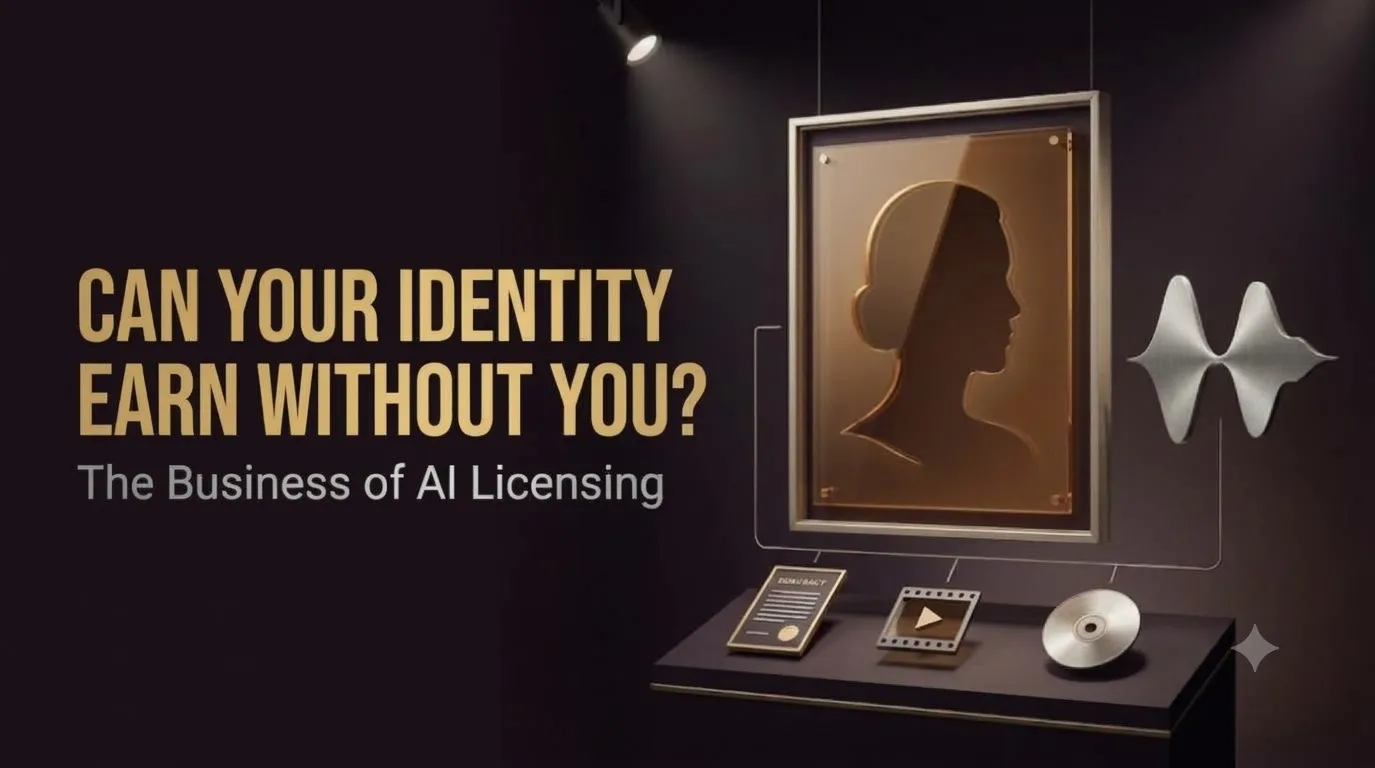
A brand brief no longer has to begin with a shoot schedule. According to Studio Blo cofounder Dipankar Mukherjee, brands can now create images and videos of celebrities in different locations and situations to suit a creative brief. He sees the bigger prize in branded content such as miniseries, microdramas and feature-length formats, and expects 2027 to be pivotal.
That changes the work for celebrities, creators and brand teams alike, and it raises a question the industry has yet to settle: who gives consent, and who gets paid? Learn how each role is affected and what must be in place first.
What Can You License as a Creator?
Your face and voice are now commercial assets, not just part of how you appear.
Here is who can license what:
-
Who: film stars, cricketers and digital creators.
-
For what: commercial use, without being physically present for every production.
Sparkonomy cofounder Guneet Singh says creators could also lease their identities for content production.
“Identity licensing could sit alongside brand partnerships, platform monetisation and sales commissions as an added income stream.”
How Large is the Market for Creator and Celebrity Content?
The money already exists. AI changes how an identity is used to reach it.
According to industry estimates, this is the market:
-
Influencer marketing: projected at Rs 3,500 crore.
-
Celebrity endorsements: estimated at Rs 3,000 crore.
-
Early adopters of AI cloning: cricketers Hardik Pandya and Shubman Gill.
“Sparkonomy’s Guneet Singh describes the creator opportunity as similar to the celebrity one, but at 1,000 times the scale.”
A market this size rewards creators who understand how brands plan campaigns and growth. PW Medharthi’s AI-Driven Marketing and Digital Growth programme is one way to learn that side of the work.
How Quickly Can AI Replicate Your Identity?
Copying takes seconds. Protection has to keep pace. According to Sparkonomy cofounder Guneet Singh:
|
What |
Detail |
|
The speed |
Identity can now be replicated within 30 seconds |
|
The need |
Creators who earn from their identity need protection and compensation when someone else uses it |
|
The response |
Sparkonomy is launching the Open Creator Graph, where creators establish their identities and specify how AI systems can use their content and likeness |
“A clone takes 30 seconds to make. Getting paid when someone else uses it is the part creators must secure.”
A 30-second clone shows how quickly AI can now work with a person's face and voice. Creators who understand how these systems work are better placed to judge what protection they need, and Certification Program in AI/ML is a practical way to build that understanding.
Which Platforms Can Help You Control Your AI Identity?
Two platforms show two approaches, one for celebrities and one for creators.
-
For celebrities: Studio Blo’s FAIMOUS
-
For creators: Sparkonomy’s Open Creator Graph (OCG), open infrastructure for establishing identities
“Studio Blo’s FAIMOUS lets celebrities control and license their AI clones, and Sparkonomy’s OCG lets creators set how AI systems use their likeness.”
Studio Blo cofounder Dipankar Mukherjee sees the bigger benefit in branded content such as miniseries, microdramas and vertical series, and expects 2027 to be pivotal.
What Should You Check Before Licensing Your Likeness?
Licensing your likeness is only as strong as the terms behind it. According to Rajesh Sethi, PwC India's leader for media, entertainment and sports, wider adoption needs these four things:
CONSENT AND LICENSING CHECKLIST
-
Standardised licensing terms
-
Verifiable consent
-
Systems to monitor usage
-
Ways to determine pricing and facilitate payments
“Wider adoption of AI cloning needs standard terms, verifiable consent, usage monitoring and payment systems in place”.
Studio Blo's Dipankar Mukherjee puts the idea in one line: "The future belongs to monetisation of consent."
Tip: Before licensing your likeness anywhere, check whether the terms say how AI systems may use it.
Who Benefits When AI Identity Licensing Becomes Mainstream?
AI identity licensing could create value for both the people whose likenesses are used and the businesses producing digital content. Celebrities and creators may gain another source of income, while brands can explore new ways to develop campaigns and video formats.
However, the commercial opportunity depends on clear agreements about consent, usage rights and compensation. As AI-generated content expands, the key question is not just how quickly an identity can be replicated, but who controls its use and receives payment.
Key Takeaways
-
Creators can license AI versions of their faces and voices without being on set.
-
Singh says the creator opportunity is 1,000 times the celebrity scale.
-
Identity can be copied in 30 seconds, so creators need protection and pay.
-
FAIMOUS serves celebrities, and the Open Creator Graph serves creators.
-
Adoption needs standard terms, verified consent, usage tracking and payment systems.
-
Courts have granted interim relief to Bachchan, Arijit Singh and Shamani.
Every step leads to the same place: control over how your identity is used
AI avatars can give creators a new income stream and open the way to new kinds of content. But before licensing your likeness, make sure the agreement clearly defines consent, usage rights, compensation and monitoring. The goal is to benefit from AI without giving up control of your digital identity.
Ready to turn this into a skills plan? The AI Career Roadmap Generator can map a learning path around your target role, skills and courses.




