
AI and Data Skills Can Deliver a 20–25% Pay Premium Across Emerging Career Paths
 Mishika Gupta16 Oct, 2026
Imagine two graduates applying for similar early-career roles. Both have relevant qualifications, but one can also analyse data, use AI responsibly and turn findings into business recommendations.
Could that extra capability make a difference to their earning potential?
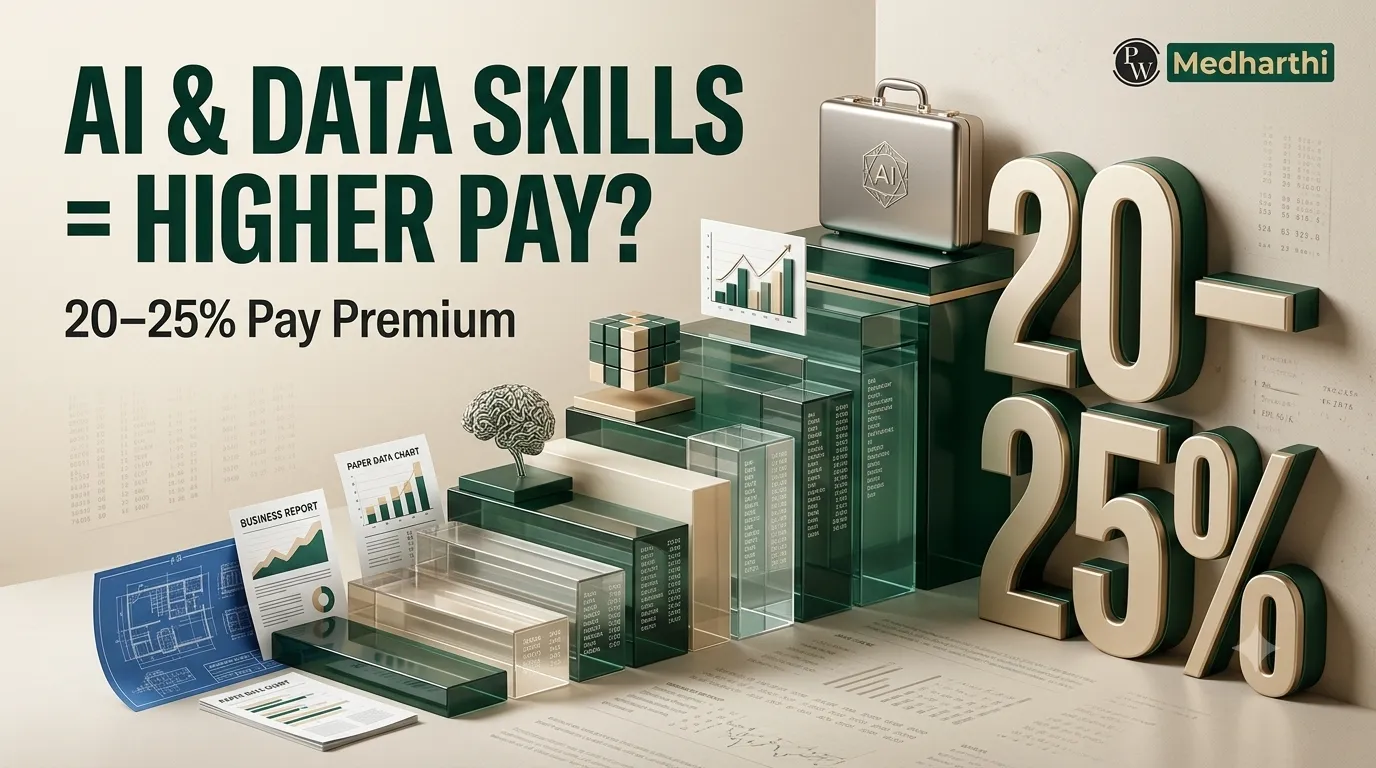
Deloitte India’s Campus Workforce Trends 2026 suggests it could. The study reports hiring premiums of 20–25% for AI and data skills, while analytical thinking and problem-solving command premiums of 10–15%.
The real question is not just which skills pay more, but how you can demonstrate them to employers.
A 20–25% Premium: What Is Deloitte Actually Saying?
Deloitte identifies AI development, cybersecurity, data science and Industry 4.0 among the skill areas attracting reported hiring premiums of 20–25%.
But let’s be clear: this does not mean completing an AI course automatically increases your salary by that amount. Compensation depends on several factors, including the role, employer, location and depth of your skills.
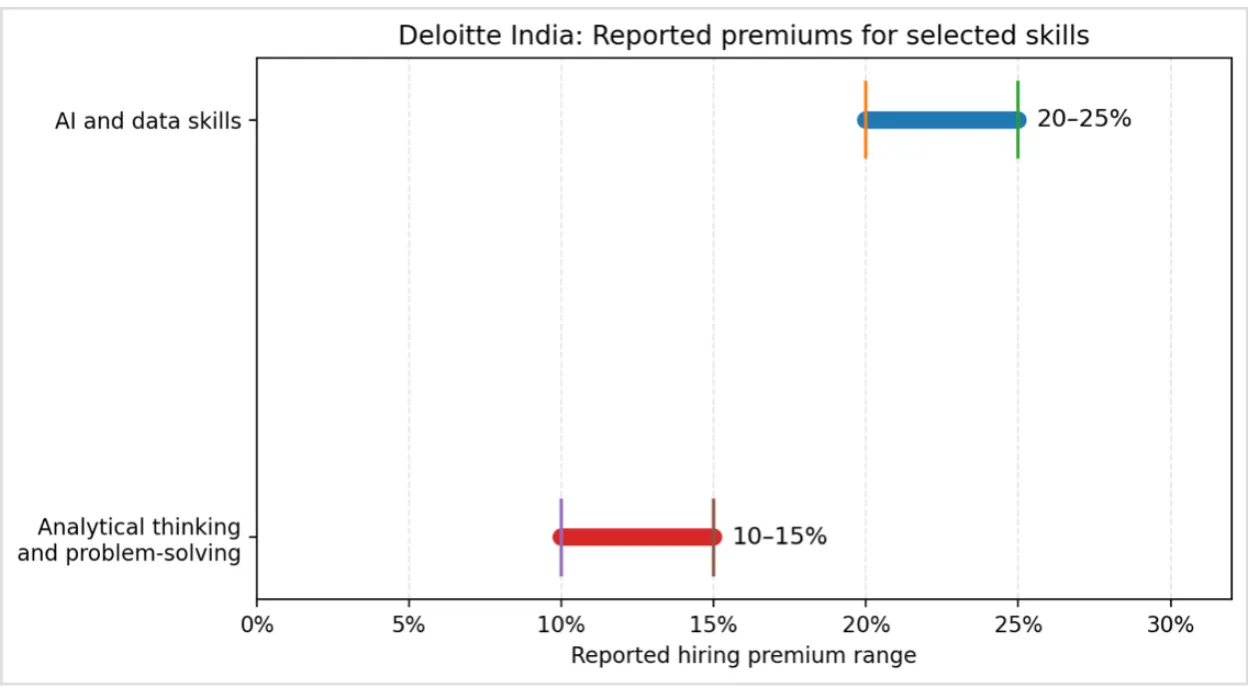
Source: Deloitte India, Campus Workforce Trends 2026 press release. The ranges show reported premiums for selected skill areas; they are not a salary forecast for every individual.
The opportunity lies in identifying relevant capabilities and learning how to apply them to real workplace challenges.
Think of the premium as a signal of employer demand, not a guaranteed salary increase.
The Bigger Shift: A Degree May Open the Door, but Skills Help Explain Your Fit
The changes extend beyond compensation. Deloitte reports that 86% of organisations say AI or agentic AI is transforming recruitment. Resume screening is the most commonly reported application (72%), followed by AI-based assessments (48%).
Meanwhile, 35% of organisations say AI adoption is creating new entry-level roles or skill requirements, up from 21% in FY25.
What does this mean for graduates? You need to prepare for both AI-assisted hiring and evolving workplace expectations.
A qualification still matters, but employers also want to understand how you approach problems, evaluate information and use technology effectively.
Curious about why AI proficiency is becoming more relevant to graduate hiring? Explore why employers want AI-skilled graduates.
Where Can AI and Data Skills Make a Difference?
You might assume these opportunities are limited to software developers or data scientists. However, Deloitte identifies AI-aligned campus roles across IT and ITeS (73%), professional services (53%) and financial services (46%).
Here are four pathways worth exploring.
1. Data and Business Analysis
Ever wondered why sales have dropped or why customers are leaving? Data analysis helps professionals investigate such questions, identify patterns and recommend practical solutions.
For those considering management education, understanding data analysis skills in MBA programmes can help clarify how analytical capabilities support business decisions.
2. AI Development and Applied AI
These roles involve developing AI models, integrating them into workflows and finding useful applications for automation. Knowing how to use an AI tool is a good start, but understanding its limitations and applying it to real problems is what makes that knowledge valuable.
And you don't necessarily need to become a developer to benefit. AI literacy is becoming relevant to management careers, too, as professionals increasingly need to interpret AI-generated insights and make informed business decisions. This shift is explored in how AI literacy is entering the MBA skill set.
3. Cybersecurity and Digital Risk
As organisations become more digitally connected, protecting information, identifying vulnerabilities and managing technology-related risks become increasingly important. These careers combine technical knowledge with risk assessment and responsible decision-making.
For students interested in the technical side, specialised pathways such as an online MCA in Cyber Security can help build relevant foundations.
4. Industry 4.0 and Smart Operations
Imagine a factory that can predict equipment failures before they happen or a supply chain that adjusts to changing demand. AI and data analytics are helping make these scenarios possible by improving maintenance, quality control and operational planning.
The common thread? Technical skills become more valuable when you understand the business problem they are meant to solve.
A Premium Is Not Just About Knowing a Tool
Imagine an AI tool summarising customer feedback while a spreadsheet identifies which product has the highest return rate. You have information, but do you know why customers are dissatisfied or what the company should change?
That requires someone to verify the evidence, question assumptions and recommend the next step.
This is where analytical thinking and problem-solving become essential alongside AI and data capabilities.
The strongest combination is technical knowledge, sound judgement and the ability to communicate findings clearly.
If you are unsure which capabilities to prioritise, PW Medharthi’s Skill Gap Analyzer can help you identify areas to explore based on your career goals.
How Can Students Turn These Signals into Evidence?
Knowing a skill and demonstrating it are two different things. A practical project can give employers a clearer picture of what you can do.
Here is how to get started:
-
Choose a real problem: Investigate declining sales, customer churn or delayed deliveries.
-
Work with data: Clean a dataset, identify patterns and acknowledge limitations.
-
Apply AI thoughtfully: Use an appropriate tool, verify its outputs and explain where human review is necessary.
-
Present a recommendation: Explain what the evidence suggests, what action you recommend and why.
-
Document your process: Create a portfolio entry covering the problem, method, findings and next steps.
Your goal is not to list every tool you know, but to demonstrate how you think and what problems you can solve.
If you want to combine business decision-making with data and generative AI, IIT Roorkee's Post Graduate Certificate Program is one learning option to explore.
The Pay Premium Sits Within a Bigger Compensation Picture
Skills are only one part of the compensation equation.
Compensation reflects several factors, including educational background, role, employer, experience and specialised capabilities. AI and data skills can strengthen your profile, but they do not guarantee a particular salary outcome.
Deloitte reports median MBA compensation of Rs. 27.4 lakh at Top 10 institutes, compared with Rs. 8.4 lakh at Tier 3 institutes. For B.Tech graduates, the corresponding figures are Rs. 18.7 lakh and Rs. 5.75 lakh. Campus compensation across major degree categories grew at approximately 2–4% compound annual growth between FY22 and FY26.
These figures measure different things and should not be directly compared with the reported skills premiums.
Key Takeaways
-
AI and data skills attract reported hiring premiums of 20–25%: Treat this as a market signal, not a guaranteed raise.
-
Analytical thinking matters too: Deloitte reports premiums of 10–15% for analytical thinking and problem-solving.
-
AI is changing recruitment and job requirements: Candidates need to adapt to evolving assessments and workplace expectations.
-
Practical projects make skills easier to assess: Show how you have applied your knowledge to solve a problem.
-
Choose skills around your career goals: Focus on capabilities relevant to your target role rather than chasing every new tool.
The Question is Not Just Which Skills Pay More
Deloitte India’s Campus Workforce Trends 2026 highlights the growing importance of AI, data and analytical capabilities in early-career hiring.
But a premium does not come from a keyword on your CV. It depends on whether you can apply a skill, explain the result and make sound decisions with it.
So, what real problem will you be able to solve once you have learned these skills?
Start there. Identify the gap between your current abilities and your target role, then build a learning plan around it. That is how an emerging skills trend can become a practical career opportunity.